The 1990s mid-to-late 1990s
Tommy Hilfiger
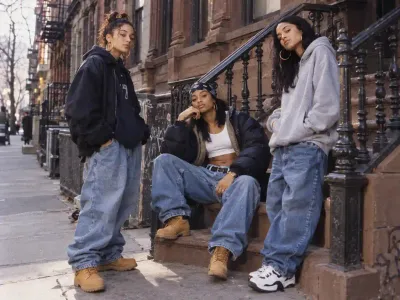
The New York sportswear label of khakis, big polo shirts and a red, white and blue flag - a menswear brand that hip-hop made famous, and that only launched a women's line in 1996, after girls had already borrowed the clothes.
Tommy Hilfiger usually gets told as a menswear story. The logomania entry has Snoop Doggy Dogg's rugby shirt and the counterfeiters who taught Hilfiger to enlarge his name, and the hip-hop silhouette entry has Aaliyah's waistband. But his early design work included girls' clothes, and the women's line he finally launched in 1996 is the most revealing part: a menswear brand trying to fit women who'd been wearing it for years.
After his first shop, People's Place in Elmira, New York, went bankrupt in the late 1970s, he designed briefly for Jordache jeans and then, according to the Encyclopedia of Clothing and Fashion, started 20th Century Survival with a women's clothing manufacturer: a junior-sportswear line of "western and nautical styles, as well as Victoriana dresses, khakis, and camouflage gear." In 1985 Mohan Murjani, the backer of Gloria Vanderbilt jeans, gave him a men's label, which Hilfiger pictured as "a more New England, outdoorsy, and classic campus look." It launched with a Times Square billboard naming "The 4 Great American Designers for Men" by initials only: R.L., P.E., C.K. and T.H. Hilfiger's name didn't appear, just his red, white and blue flag logo. In 1990 the New York Times still thought "the stunt never came off." An early try at womenswear under Murjani was dropped.
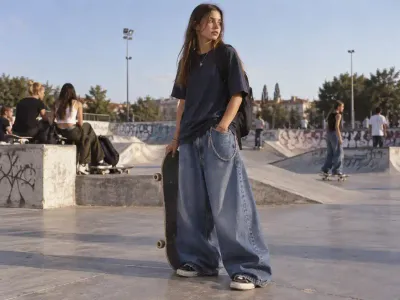
One company history calls khaki pants and a big polo shirt "the quintessential Hilfiger outfit," with "a little more flippancy in the cut and colors than the more staid Ralph Lauren style" that Murjani had set out to copy. That flippancy was mostly colour - his "signature red, white, and blue styles," often the flag's three colours pieced together in blocks. For a sewer that's a construction decision: every change of colour is a seam, and each block has to meet its neighbour at the side seams and armholes. In 1994 Newsweek set him against Calvin Klein in a showdown over underwear. Hilfiger, posing with models in flag-and-stripe boxers that Contemporary Fashion describes as "surfer jam length," said his image was "all about good, clean fun." Meanwhile city kids were wearing these "essentially suburban" clothes extra large, and Hilfiger answered with sizes labelled "giant" and bigger logos - the clothes the oversizing entry takes apart - while his brother Andy handed out logo shirts on music-video sets. In 2025 he told the CFDA the lesson was that "fashion isn't dictated from the top down."
Womenswear took three tries. In March 1994 the company hired Jay Margolis as president specifically to build it. A year later the plan was dropped as too expensive, Margolis resigned, and the line was licensed to Pepe Jeans, a company owned by Hilfiger's chairman, Silas Chou. It reached more than 400 department-store shops in 1996, alongside the Tommy Girl fragrance. The first Tommy by Tommy Hilfiger collection offered tailored tweed jackets and wools, but customers kept buying "denim, chinos, and logo pieces," so the line was redesigned around them and took $125 million wholesale in its first year. Aaliyah's 1996 jeans campaign, which Hilfiger credits to Andy, is in the hip-hop entry; he remembers "the way she wore oversized pieces with a blend of street and sophistication." Tommy Jeans then went after 14- and 15-year-olds, with advertising aimed at readers of Seventeen and Teen People - the teen-magazine market.
The peak came in 1999, with a girls' line, cosmetics, handbags, a European women's line and Tommy Jeans sponsoring Britney Spears's first tour, as the Y2K silhouette took shape. Then Fortune said in 2000 that Tommy had "rested on its red, white, and blue laurels too long." Customers complained that the women's clothes were "too trendy and did not fit well," and the line went back to basic preppy. I'm not surprised. The women who made the brand look good had worn it big and borrowed, and a line cut to fit them neatly may have been answering a question they never asked.
Sources
- Tiffany Webber-Hanchett, "Hilfiger, Tommy" - Encyclopedia of Clothing and Fashion; with Richard Martin and Karen Raugust, "Hilfiger, Tommy" - Contemporary Fashion, via Encyclopedia.com
- "Tommy Hilfiger Corporation" - International Directory of Company Histories and Company Profiles for Students, via Encyclopedia.com
- Rashad Benton, "Tommy Hilfiger on Legacy, Innovation, and Embracing Hip-Hop" - CFDA, 4 February 2025
- Doris Daga, "Tommy Hilfiger revisits the music archives to launch Tommy Jeans" - Vogue Scandinavia, 19 October 2021