The 1980s early 1980s
The New Romantic Silhouette
Ruffled shirts, exaggerated volume, and deliberately blurred gender lines - a theatrical, dandyish look built for a generation raised on music videos rather than concert halls.
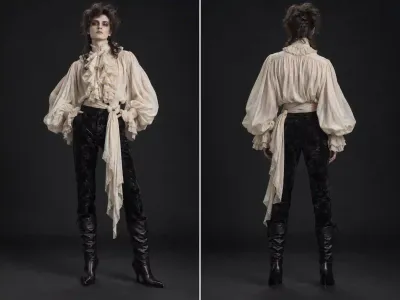
New Romantic dressing borrows its exaggeration from an odd mix of sources at once - Regency-era ruffled shirts, pirate-costume volume, geisha-inflected makeup, glam rock's earlier gender play - and mashes them into a silhouette that reads as deliberately theatrical rather than aiming for any kind of everyday wearability. Full sleeves gathered at a ruffled cuff, high collars, sashes and scarves layered for volume rather than warmth, dramatic makeup on men as much as women: the whole point is visual excess large enough to read clearly on a small television screen, since this look and the music video format arrive at essentially the same moment.
That's the detail that makes this silhouette worth separating from a general "new wave" catch-all: it's built around loose, voluminous draping rather than fitted tailoring, relying heavily on batwing and dolman sleeve construction to get enough fabric moving without adding real weight or bulk to a garment. A sleeve cut this way reads as huge on camera while still letting an arm move freely on stage - a genuinely practical solution to a specifically televisual problem, dressing for a lit stage and a music-video camera rather than a boardroom or a sidewalk.
The gender-blurring is, I think, the part that actually outlasted the specific look. Boy George and Annie Lennox both built entire public personas around silhouettes that refused to signal "masculine" or "feminine" cleanly, and MTV, launched in August 1981, gave that refusal a genuinely mass audience for the first time rather than confining it to a small club scene. Compare that directly against the crisp, hyper-gendered tailoring the power silhouette was selling in boardrooms during these same exact years, and you get a real sense of how many contradictory ideas about what a body was supposed to communicate this decade was running simultaneously, rather than moving through one clean, linear silhouette shift the way some earlier decades did.