The Victorian Era Crinoline era onward (1860s–1901)
The Mantle, Dolman and Ulster
The outerwear that took over from the shawl once skirts moved backward - loose mantles, the bustle-shaped dolman with its sleeves cut in one with the body, and the long, practical ulster for travelling.
The Paisley shawl entry ends around 1870, when the bustle made big draped shawls impractical. This entry picks up from there, because what replaced the shawl tells you a lot about how awkward Victorian skirts were to dress over.
"Mantle" was the general Victorian word for a loose outer garment worn over a dress, somewhere between a cape and a coat. During the crinoline era, short mantles and mantelets - capes that covered the shoulders and arms - were worn alongside shawls, because nothing fitted could go over such a wide skirt. Once the silhouette flattened at the front and gathered at the back, outerwear had a new problem to solve: it had to make room for a bustle.
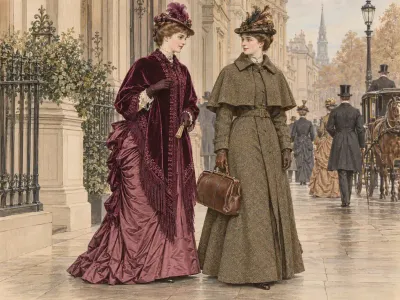
The dolman was the neatest answer. Named after a Turkish robe, it was a mantle whose sleeves were cut in one piece with the body, so the arms were partly held against the sides rather than moving freely - hence the later "dolman sleeve," which returned in the 1980s. The key feature was the back: short, shaped, or split so it sat neatly over the bustle, often with long hanging panels or tabs at the front. Dolmans were made in wool, velvet, silk, or brocade, and trimmed lavishly with fringe, braid, jet beading, lace, or fur. They were elegant, but not very practical - you couldn't lift your arms far in one.
The ulster was the practical opposite. It began as a long, loose men's overcoat, introduced by the Belfast outfitter John G. McGee in the late 1860s, made from heavy wool and often with a short shoulder cape attached. Women adopted it from the 1870s, especially for travelling by train and steamer, where warmth and protection from dirt mattered more than fashion. A woman's ulster was long, straightforward, and belted or buttoned, usually in tweed or plain wool, and it fits the same practical, tailored strand of dress as the tailor-made walking suit.
By the 1890s, fitted jackets and capes with high, puffed shoulders had largely taken over from the dolman. But I find these garments a very useful way to "read" a Victorian photograph: a dolman's short, shaped back tells you instantly that you're in the bustle years, while an ulster suggests travel, weather, and a more practical, modern woman.