The Victorian Era Victorian era, broadly
Velvet
A dense, pile-woven fabric associated with wealth and formality - a staple of eveningwear and winter dress throughout the era, and one of the fabrics most transformed by industrial-era production.
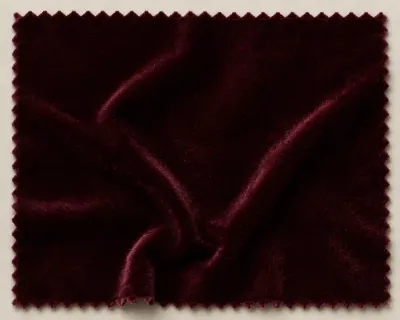
Velvet carries a lot of visual weight in this era's portraiture - it reads as substantial and expensive in a way that's hard to fake, which is exactly why it shows up so often in formal and mourning-adjacent dress alike.
The cost story is a dramatic one, and it maps almost exactly onto the century's broader industrial arc. At the start of Victoria's reign, genuine silk velvet - woven on a drawloom with an extra warp that gets cut to form the pile, an intensely slow and skilled process - was a serious luxury fabric, priced accordingly and largely reserved for the wealthy or for special-occasion pieces even among those who could afford it. The introduction of power looms adapted specifically for pile-weaving through the middle decades of the century, along with the broader mechanization sweeping textile production generally, brought velvet's price down substantially by the century's later decades, while cotton velvets and velveteens - a shorter-pile, less expensive alternative using cotton rather than silk - opened the look up to a much wider range of budgets entirely. By the 1880s and '90s, velvet trim, if not a full velvet gown, was achievable for a solidly middle-class wardrobe in a way that would have been unthinkable fifty years earlier.
What I find genuinely striking, though, is that velvet never lost its visual association with wealth even as it became more accessible - a phenomenon that shows up with a few other Victorian fabrics too, where the cultural meaning of a material lags well behind its actual economics. Part of that is simply velvet's physical qualities doing real work regardless of price point: that dense, light-absorbing pile reads as substantial and rich to the eye in a way thinner, flatter fabrics simply can't fake, which is exactly why it recurs so often in formal portraiture and in mourning-adjacent dress, where a deep, matte black surface carried real symbolic weight. Velvet got cheaper across the century, in other words, without ever really getting less impressive to look at - a rare case of mechanization improving access without diluting the fabric's visual authority at all.