The Victorian Era Bustle era, both phases (1870s–1880s)
Bustle Mechanisms
A close look at how the bustle was actually built - wire cage structures in the first phase versus the more elaborate, shelf-like pad-and-frame structures of the second - and how the engineering differs between them.
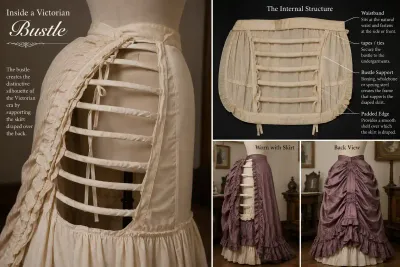
The two bustle phases look related from a distance, but the actual structures underneath are quite different - the first phase's wire half-cage produces a softer, more draped back, while the second phase's shelf needs real rigid framing to jut out the way it does. They're not directly consecutive, either: the slender Natural Form Era sits between them for roughly six years, with the bustle essentially dropped altogether before it returns bigger and more architectural in the 1880s.
The hardware itself tells the story better than any description of the finished silhouette can. The first phase typically relies on a fairly simple half-cage - a handful of curved steel or whalebone hoops, graduated in size and joined by fabric tapes much like a scaled-down crinoline cut in half, tied at the back of the waist and left to project only as far as its own light structure and the drapery layered over it will carry. It's genuinely closer in engineering spirit to the crinoline it evolved from than to what comes next.
The second phase's signature piece, by contrast, is the so-called "lobster-tail" bustle - a series of articulated steel half-hoops, hinged so they could concertina flat when the wearer sat down and spring back out when she stood, producing that shelf-like, almost right-angle projection that makes 1880s photographs so instantly recognizable. Some versions paired that wire structure with a stuffed horsehair or down pad for additional shape and cushioning where the frame met the body; more elaborate examples were sold as complete boned understructures, essentially a specialized corset extension built solely to carry the bustle's weight and keep it correctly positioned through a full day of wear. The hinge mechanism is the real engineering leap between the two phases - it's what let the second bustle be simultaneously more extreme in silhouette and more practical to actually sit down in, which is no small thing given how much Victorian social life happened seated. Comparing the two side by side, hoops-and-tapes versus hinged articulated steel, is as good a single illustration as any of how much more confident and technically ambitious Victorian understructure engineering had gotten in just one decade.