The Victorian Era Natural form era (late 1870s–early 1880s)
Natural Form Era
A brief, notably slender, close-fitting silhouette between the two bustle phases - often overlooked but a genuinely distinct look.
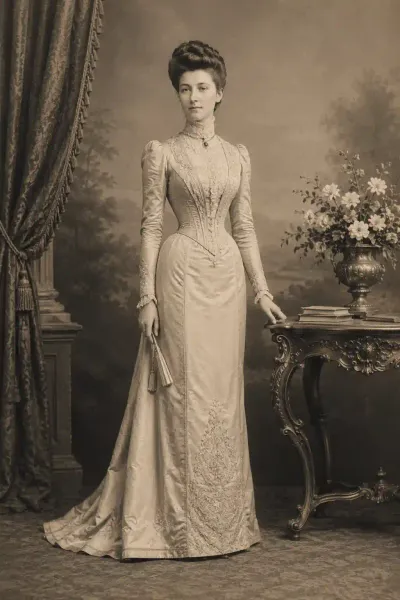
This is the sub-period I most want people to stop skipping - it's often flattened into "the bustle era" in casual accounts, but the natural form silhouette is actually the leanest, most body-skimming shape of the whole Victorian period.
What changed underneath is, essentially, subtraction. The bustle structures of the 1870s are set aside almost entirely, and the fashionable line instead relies on a long, tightly fitted, often boned bodice - sometimes called a cuirass bodice, extending well past the natural waist down over the hips like a piece of armor - paired with a skirt cut close through the hip and thigh, with any remaining fullness pushed low, toward the knee and hem, rather than out behind the body. The corset itself has to do more work here, not less: with no bustle or crinoline to distract the eye, a smooth, unbroken line from bust to hip is entirely on the corset and the bodice's own boning to deliver, which is part of why I'd argue this sub-period represents corsetry's most demanding stretch rather than its most relaxed one, despite how "natural" the resulting silhouette looks next to its neighbors.
It's a genuinely difficult shape to move in, too, which I think is underappreciated - that cuirass bodice and close-fitting skirt restrict the stride in a way the bustle silhouettes, for all their bulk, actually didn't. So it's not surprising this look doesn't last: it's demanding to wear, demanding to construct well, and by the mid-1880s fashion swings hard back toward volume with the second bustle phase - bigger and more shelf-like than the first ever was, as if making up for lost time. I like to think of the natural form years as the eye of the storm between two very different bustle silhouettes: a brief, lean pause that's easy to flatten into "the bustle era" in a quick survey, but rewards a closer look precisely because it breaks the pattern on either side of it.