The Victorian Era Victorian era, broadly
The Bodice Dart's Evolution
Dart placement and count shifted considerably across the era's silhouette changes, from the simpler shaping of early Victorian bodices to the more elaborate princess-seamed construction of the 1890s.
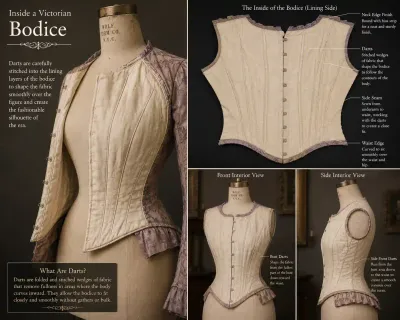
This is the kind of detail that's easy to miss unless you're actually sewing from period patterns - the number and placement of bodice darts tells you almost as much about which sub-period a garment is from as the silhouette does.
Laid side by side, the shift is really a story of increasing precision rather than any single dramatic change. Early Victorian bodices, with their soft, sloped shoulder and moderate waist definition, generally get by with a simple pair of underarm darts and perhaps a waist dart on either side - enough to shape fabric around the bust and into the waist without needing to fight much structure, since the era's whole silhouette philosophy is comparatively soft to begin with. Move into the crinoline era and the darts multiply slightly and shift position, often adding a shoulder dart to help the bodice sit smoothly over more structured shoulder seaming, while the waist stays the era's real focal point and gets the most careful dart placement to achieve the sharp contrast against all that skirt volume below.
By the bustle decades, and especially by the glove-fitting construction of the 1870s onward, the whole approach changes rather than just adding more darts - pattern pieces increasingly replace darts altogether with continuously curved seams, since a curved seam shapes fabric more smoothly across a longer distance than a single dart intake ever can. By the 1890s, princess-seamed bodices (seams running unbroken from shoulder or armhole straight down to the hem, doing the shaping job a dart-and-waist-seam combination used to split into two separate operations) represent close to the opposite extreme from where the era started: almost no traditional darts at all, just continuous, precisely curved seaming doing the same fundamental job with far more sophistication. If you're ever trying to date an unlabeled bodice from a photograph or an extant garment, dart count and placement is honestly one of the more reliable tells available - often more so than trim or fabric, which fashion could recycle across decades in a way structural pattern technique generally didn't.