The Victorian Era Late Victorian (1875–1901)
The Tea Gown
A loose, flowing gown worn at home for afternoon tea, often over a lighter corset or none - the one socially acceptable moment in a fashionable woman's day to relax her silhouette, and a slightly daring one.
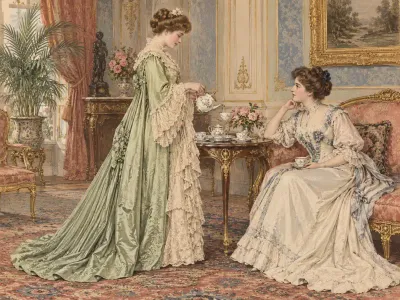
Victorian women of the upper and middle classes changed their clothes several times a day - morning dress, walking dress, visiting dress, dinner dress. The tea gown filled a gap in that schedule, in the late afternoon, and it was the most relaxed of them all. I think it's one of the most interesting garments of the late century, because it quietly let the body breathe.
Afternoon tea became an established social ritual in the mid-century, and by the 1870s it was usual for a hostess to receive close friends at home at around five o'clock. For this private, informal occasion, a new kind of garment developed: a long, loose gown that didn't need the tightly fitted bodice of formal dress. Tea gowns were usually unfitted or only loosely fitted, often with flowing panels at the back like the eighteenth-century "Watteau" pleat, wide sleeves, and a soft train. Many could be worn with a lighter corset or, more daringly, without one, and they were easier to put on without the help of a lady's maid.
The inspiration came from all over the place: historical dress, Japanese kimonos, and especially the Aesthetic movement's loose, uncorseted gowns. Liberty sold tea gowns made from its soft art fabrics, and the grand Paris houses, including Worth and later Paquin, made spectacular versions in silk, chiffon, velvet, and lace. By the 1890s they had become very elaborate - cascades of lace, ribbon, and embroidery - and some were almost indistinguishable from evening wear, except that they were never worn outside the house.
There was also a whiff of scandal about them. A loose gown, worn at home, possibly without a corset, in the company of intimate friends, suggested a kind of ease and closeness that made moralists uncomfortable, and tea gowns turn up in novels and gossip as the costume of flirtation. That's part of why I find them so interesting. Everywhere else in Victorian dress, respectability meant structure. The tea gown was a small, private space where a fashionable woman could be both elegant and comfortable at once - and its loose, flowing lines point directly toward the softer dress of the early twentieth century.