The Victorian Era Victorian era, broadly
Lace
Hand-made bobbin and needle lace gave way over the century to machine-made lace, a shift that mirrors the era's broader move from hand construction to mechanized production.
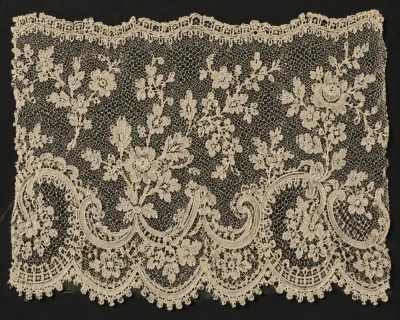
Lace is a great small case study for the era's larger industrialization story - the same decades that bring the sewing machine into dressmaking also bring machine-made lace that's genuinely difficult to tell from hand-made at a glance.
The distinguishing marks are subtle but real once you know to look for them, and it's a skill worth having if you're ever examining a period piece rather than a photograph. Hand-made bobbin or needle lace tends to show small, natural irregularities - thread tension that varies slightly across a motif, knots and joins where a lacemaker had to add new thread, a ground mesh that isn't perfectly uniform because it was built stitch by stitch rather than mechanically. Machine-made lace, which improves dramatically in quality across the century (particularly after the Jacquard mechanism was adapted to lace-making looms), tends toward a more mechanically perfect regularity - a mesh ground of genuinely identical cells, motifs repeated with an exactness a hand rarely achieves over a long length of trim. By the century's later decades machine lace had gotten good enough that it fooled plenty of contemporary buyers too, not just modern ones; period etiquette and household guides occasionally warn readers about being sold machine lace at hand-lace prices, which tells you the deception was a real commercial problem, not just a historian's curiosity now.
I think the more interesting story here, though, is what that near-indistinguishability actually did to lace as a status marker. For centuries, fine lace had been one of the clearest visible signals of wealth precisely because it was so labor-intensive to produce by hand - a single collar could represent weeks of skilled work. Once machine lace closed that visual gap, lace stopped reliably communicating "this person can afford genuine luxury" and started, for a portion of the market, communicating something closer to "this person understands current fashion," which is a real shift in what the fabric was doing socially. It's the same industrialization story playing out across hand-sewing to machine-sewing more broadly - mechanization doesn't just make production faster, it quietly redefines what scarcity, and therefore status, even means.