The Victorian Era Victorian era, broadly
Victoria's Influence Beyond Mourning
Beyond her decades of mourning dress, Victoria's own choices - including popularizing the white wedding dress - shaped fashion norms that outlasted her reign considerably.
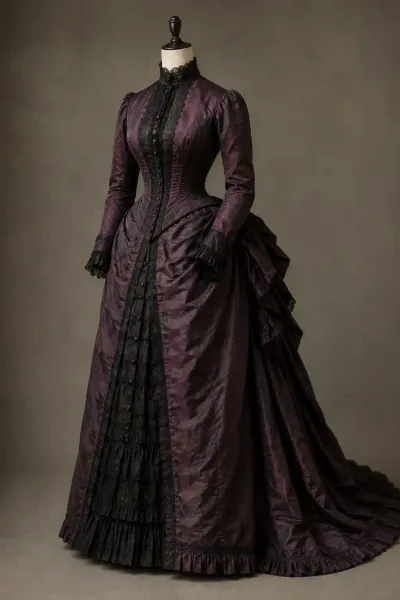
It's easy to think of Victoria's fashion influence as just the mourning story, but her 1840 wedding dress is arguably the bigger long-term legacy - white bridal dress wasn't yet the default before her, and it very much became one afterward.
Before Victoria's own wedding in February 1840, white wasn't the default bridal color it is now - brides of means simply wore their best dress, in whatever color suited them, and plenty of Victorian-era brides continued doing exactly that for years afterward, since Victoria's choice took time to calcify into a firm expectation. Her white satin gown, trimmed with Honiton lace to support the local lace industry (a deliberate economic choice on her part, not purely an aesthetic one), was widely illustrated and discussed in the period press, and over the following decades "a white wedding dress" gradually shifted from one fashionable option among several to something closer to an assumed default for anyone who could afford a dedicated wedding gown at all - a norm so thoroughly absorbed by the twentieth century that most people today would guess it's far older and more universal than it actually is.
The wedding dress is really the clearest single example of a broader mechanism, though: royal public appearances functioned, throughout the era, as a genuinely powerful trend-distribution channel, well before mass media existed in any modern sense. A garment or color Victoria wore to a public event got illustrated in periodicals like Godey's Lady's Book and its British counterparts within weeks, reaching a female readership far larger than any single dressmaker's client list - mauve, discussed at length in the aniline dyes entry, owes a real debt to Victoria wearing it publicly in 1858, on top of the dye's own novelty. Mourning dress remains the most sustained and visible example of this pattern, simply because it ran for decades rather than a single event, but I think it's worth treating as one instance of a wider habit: for over sixty years, what one specific woman wore in public had an outsized, well-documented ability to reshape what the rest of the country considered normal.