The Victorian Era Victorian era, broadly
Mourning Dress
A genuinely distinct category of Victorian dress - specific fabrics, colors, and cut governed by strict, codified stages of mourning.
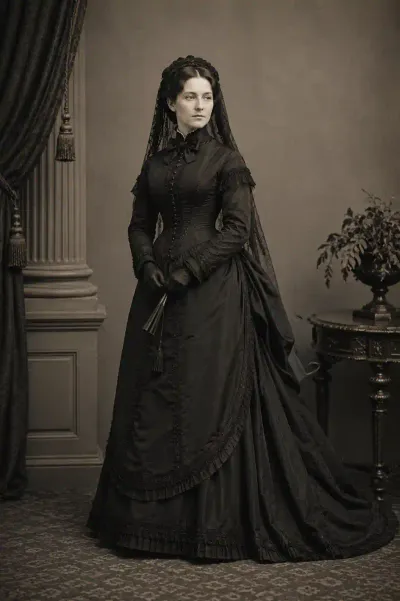
Mourning dress isn't just "wearing black" - it's a whole separate wardrobe category with its own fabrics, its own timeline, and its own rules about what could be worn at each stage. Victoria's own decades of mourning after 1861 only intensified how seriously this was taken.
The stages were genuinely codified, laid out in etiquette manuals with a level of specificity that's easy to underestimate today. "Full" or "deep" mourning, worn for a spouse for roughly the first year, called for dresses made entirely of dull, non-reflective black - no silk sheen, no trim that caught the light - and this is exactly where mourning crape does its specific work: a stiff, crimped black silk fabric, deliberately matte, that became the visual shorthand for "deepest mourning" across the whole era. As the mourning period progressed through "second mourning" and then "half-mourning," the rules loosened in careful increments - crape came off first, replaced by ordinary black silk or wool; then small amounts of trim were permitted; finally, in half-mourning, a narrow range of muted colors (gray, mauve, lavender, deep purple) became acceptable before a return to ordinary dress. The exact duration varied by relationship - a widow's mourning for a husband could stretch two full years or more, mourning for a parent or child somewhat less, more distant relatives less still - and etiquette manuals published detailed tables so no one could plausibly claim ignorance of what was expected.
Victoria's own conduct after Albert's death in 1861 is impossible to leave out of this entry, because her forty remaining years of near-continuous mourning dress had an outsized effect on how seriously the whole culture treated these rules - a monarch visibly modeling the strictest possible interpretation of mourning etiquette for decades gave the entire system a kind of moral authority it might not have carried under a less devoted example. What strikes me most, working through this as a dressmaker myself, is the sheer logistical burden it placed on ordinary households: a full wardrobe essentially had to be rebuilt in an entirely different palette and fabric on short notice, at genuine expense, precisely at the moment a family could least afford the disruption - which is exactly the tension the dress reform movement and plenty of quieter contemporary critics pointed to directly.