The Victorian Era Victorian era, broadly
Mourning Jewelry
Jewelry made from jet, hairwork, or black enamel, worn as part of formal mourning dress - a genuinely distinct craft tradition that grew directly out of the era's strict mourning customs.
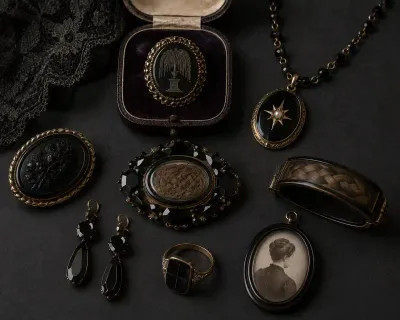
Hairwork jewelry is the piece of this that always gets people - jewelry made from a deceased loved one's actual hair, worked into brooches and lockets. It sounds strange now, but it makes complete sense inside how seriously the era treated mourning as a whole.
Jet is the other material that defines this whole category, and its rise is really a Whitby story specifically. Whitby jet - a dense, fossilized wood found in the cliffs and beaches around that Yorkshire town - had been carved locally in small quantities for generations, and was already a firmly established industry by mid-century, boosted further by the 1851 Great Exhibition; Victoria's adoption of it for her own mourning jewelry after Albert's death in 1861 then pushed an already-thriving trade to its real peak. It's a hard, deep black material that takes a beautiful polish while staying appropriately matte and unreflective when left unpolished, which mattered enormously under the strict mourning etiquette of the period: reflective, sparkling jewelry was considered inappropriate for full mourning, so jet's ability to be worked either way - high-polish for later mourning stages, deep matte black for the earliest and strictest phase - made it uniquely suited to the era's very codified rules about what could be worn when. At its peak in the 1870s, Whitby had literally hundreds of jet workshops employing around fifteen hundred carvers, which is a genuinely remarkable amount of an entire town's economy built on a single, narrowly-defined fashion requirement.
Hairwork deserves its own word too, because it's easy to read as morbid rather than what it actually was, which was intimate. A brooch or bracelet worked from a loved one's hair - sometimes the deceased, sometimes kept as a token from someone living, since hairwork jewelry wasn't exclusively for mourning - was a way of keeping a literal physical piece of a person close, at a time when photography was still expensive or entirely unavailable to most families. Once you set it against that context rather than a modern lens, it stops looking strange and starts looking like one of the more genuinely tender objects the era produced. Between jet and hairwork, mourning jewelry is a good reminder that this era's mourning customs weren't just restrictive rules imposed from above - they generated real craft traditions people invested in emotionally, not just dutifully.