The Victorian Era Victorian era, broadly
Mourning Customs
Strict, codified mourning customs - especially after Victoria's own extended mourning for Albert from 1861 - shaped a whole distinct category of Victorian dress.
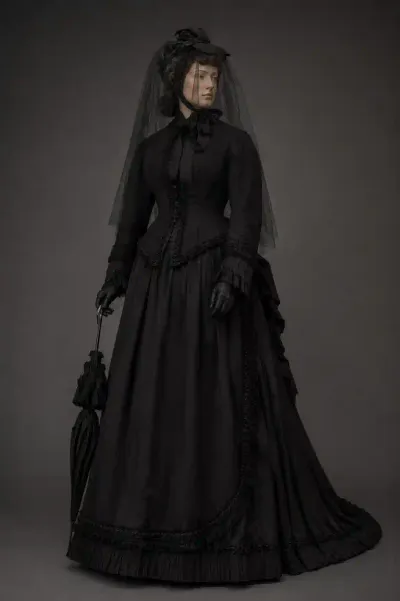
Victorian mourning is a genuinely elaborate system - specific fabrics, specific stages, specific lengths of time - and Victoria's own decades of mourning after 1861 set the tone for the whole rest of the era.
The stages themselves, and the crape fabric marking the strictest of them, get full dedicated treatment in the mourning dress and mourning crape entries - what I want to focus on here is the sheer scale and codification of the system as a piece of Victorian culture in its own right, separate from the specific garments involved. Etiquette manuals through the era published detailed, near-legalistic tables specifying exact mourning duration by relationship - roughly two years for a widow mourning a husband, a year for a parent or child, progressively shorter for more distant relatives - with each period further subdivided into stages that dictated precisely which fabrics, trims, and even jewelry were acceptable at each point. This wasn't informal social pressure; it was a widely shared, published, and genuinely enforced code, and deviating from it visibly - wearing color too soon, or crape too long past what was expected - carried real social consequences in a culture that read clothing as a direct, legible statement about a person's character and propriety.
Victoria's own conduct after Prince Albert's death in December 1861 is the single biggest reason this system carried the cultural weight it did for the rest of the century. She wore mourning dress, in some form, for the remaining forty years of her life and reign - never fully returning to ordinary court dress - and a monarch modeling the strictest possible interpretation of mourning etiquette, for decades, gave the entire cultural apparatus around it an authority it might well have lacked under a less devoted example. I think that's worth sitting with as its own historical fact, separate from the fashion details: an entire nation's mourning customs, for the better part of half a century, were shaped substantially by one woman's extended, deeply personal grief, playing out in full public view the whole time.