The Victorian Era Crinoline era onward (from 1856)
Aniline Dyes and Mauveine
The first commercially successful synthetic dye, mauveine, discovered in 1856, opened up a vivid new color palette that natural dyes simply couldn't produce at scale.
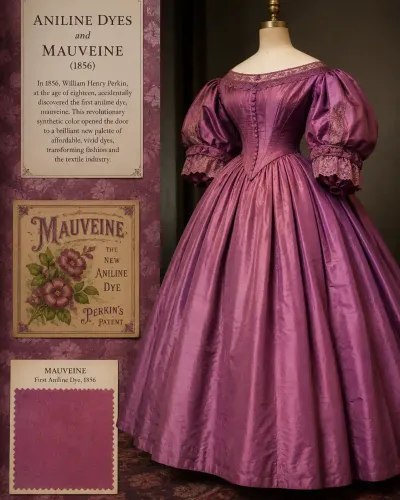
I think this is one of the genuinely underappreciated stories in the whole era - a teenage chemist's failed malaria drug experiment ends up reshaping what color Victorian fashion could even be.
The story is worth telling in full because it's such an unlikely origin for a fashion revolution. In 1856, eighteen-year-old chemist William Perkin was attempting to synthesize quinine - an anti-malarial drug - from coal tar derivatives in a home laboratory in London, and failed completely at that goal. What he got instead was a thick, useless-looking black sludge that, when he tried cleaning it off with alcohol, dissolved into a brilliant, saturated purple. Perkin had the wit to recognize that a stable, vivid purple dye that could be produced synthetically, cheaply, and at scale from coal tar - a waste product of the gas industry, essentially free raw material - was worth far more than the drug he'd been chasing. He patented the dye, named it mauveine, and had a working factory producing it within about two years, at nineteen years old.
Before mauveine, a color this saturated and this stable essentially didn't exist for ordinary consumers - the closest natural equivalent, Tyrian purple, required thousands of crushed sea snails per garment and had been a marker of imperial wealth since antiquity for exactly that reason. Mauveine made a comparable shade available to anyone who could afford ordinary dressmaking, and the color caught on with genuine fervor once Empress Eugénie of France and, notably, Queen Victoria herself were seen wearing mauve - Victoria wore it to her own daughter's wedding in 1858, which is about as strong an endorsement as Victorian fashion could receive. What followed was fast and industrial in scale: within a decade, chemists across Britain, France, and especially Germany had synthesized an entire new palette from the same coal-tar chemistry - fuchsine, aniline black, various greens and blues - kicking off a synthetic dye industry that, by the century's end, had fundamentally restructured European chemical manufacturing, not just fashion. It's a genuinely rare case of a single teenager's failed experiment reshaping both an industry and, quite literally, the color of an era's clothing.