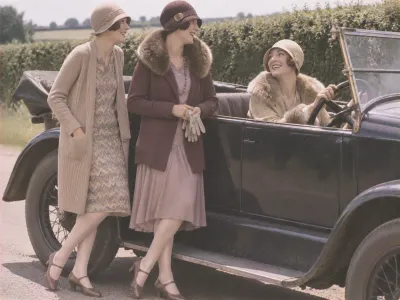
The 1920s mid-to-late 1920s (Vogue's Chanel 'Ford', October 1926)
The Little Black Dress
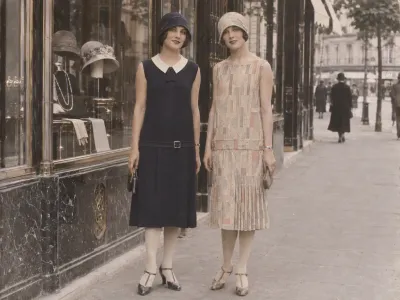
In October 1926 American Vogue called a plain black Chanel day dress a 'Ford', the frock the whole world would wear. The prediction came true. The idea that she invented black is another matter.
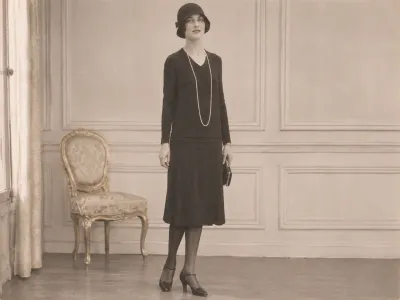
On 1 October 1926 American Vogue ran its feature on the new season, "The Debut of the Winter Mode," and among the drawings was a black day dress by Chanel: straight, long-sleeved, the hem just below the knee. The caption, as Vogue itself has since quoted it, called it "The Chanel 'Ford'" and went on: "the frock that the world will wear is model 817 of black crepe de chine." (Later retellings, the V&A's among them, usually make it "the frock that all the world will wear.") The comparison was to Henry Ford's Model T, the car that was everywhere because it was simple, standard and endlessly reproduced. Vogue wasn't saying the dress was cheap. It was saying that anyone could copy it, and that soon everyone would.
No museum, as far as I can find, holds the dress in the drawing. When the National Museum of Scotland opened its 2023 exhibition Beyond the Little Black Dress, it began with a 1926 Chanel day dress in black silk crêpe lent by the Kunstgewerbemuseum in Berlin, and the curator, Georgina Ripley, was careful to say it was not the dress in Vogue but the same style in the same sort of fabric. She also pointed out that little black day dresses of the period are rarely found in collections. That makes sense to me as a dressmaker. A beaded evening dress was worn a handful of times and put away; a good black day dress was worn until it shone at the elbows and then cut down or given away.
Where the story needs care is the word "invented." Black was not a new colour for women's clothes in 1926. As the V&A puts it, before Chanel black was associated with "service, shop assistants and mourning dress," the colour of the maid's uniform, the shop floor and the long Victorian rituals of mourning. The V&A also says plainly that Chanel "was not the only designer to promote black in fashion." The Museum at FIT goes further in its catalogue entry for a Chanel evening dress of about 1926: other houses, Premet in particular, had already sold innumerable simple black dresses, neatly trimmed with white lace collars. And Chanel herself had been showing black for years. Her black georgette evening dress for spring/summer 1923, embroidered by Kitmir, is in the V&A, and the Coco Chanel entry looks at it closely.
So what was new in 1926? Mostly the combination. The garçonne silhouette had stripped the dress down to a straight tube, and the knee-length hemline had shortened it. On a shape that plain, black removes the last distraction, so everything depends on the cut and the surface. Crêpe de Chine helps: its twisted yarns give a soft, very slightly grainy surface that breaks up the light, so the black never looks flat. FIT's own Chanel of about 1926 shows how much could still go into a black dress: black silk satin with an ecru Alençon lace yoke and wrist trims, sawtooth bands inset at the lower edge of the tunic bodice and across a wide hip band, and a knife-pleated lower skirt.
The National Museum of Scotland exhibition also recalled that the dress drew on menswear and on what maids and shop workers wore, and that Paul Poiret mocked the whole style as "poverty deluxe." The jibe tells you what bothered him: the plainness looked borrowed from the people who served the rich. In the end it was Poiret's kind of fashion that dated. Vogue's prediction came true, though not because Chanel discovered black. A plain dark dress that relied on cut, fabric and a few accessories could be copied at every price, which was exactly what the Ford comparison meant. Black went on into the next decades, through Chanel's own 1930s collections and on to the 1950s cocktail dress, where it became a type of its own.
Sources
- Lilah Ramzi, "A 1920s Fashion History Lesson: Flappers, the Bob, and More", 22 June 2024 - Vogue Philippines (first published on Vogue.com)
- "What makes Chanel so iconic?" - V&A
- "Curators 'delighted' to add Chanel's 1926 little black dress to show" (National Museum of Scotland, Beyond the Little Black Dress, 2023) - Oman Observer
- Evening dress, black silk satin with ecru Alençon lace, Chanel, c. 1926 (80.13.4) - The Museum at FIT
- Evening dress, black silk georgette embroidered by Kitmir, Coco Chanel, spring/summer 1923 (T.86-1974) - V&A Collections