The 1920s throughout the 1920s
The Cardigan Suit
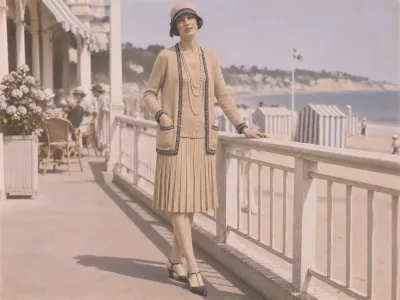
An unlined, collarless jacket that opened like a cardigan, a straight skirt and a jersey sweater: sportswear turned into town clothes, and copied by everyone from the House of Worth to the home knitter.
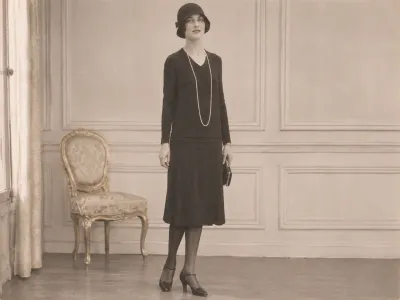
The Kyoto Costume Institute has a Chanel day ensemble of about 1928 that the museum counts among her best-known works. It is three pieces: a jacket and a knee-length skirt in black wool crêpe, neither of them lined, and a white wool jersey sweater underneath, with a black-and-white carnation pinned on as a corsage. The jacket is unlined and unstructured, and that is what makes it a cardigan suit. The name comes from the cut rather than the fabric. Like a knitted cardigan, the jacket is collarless, opens straight down the front and hangs from the shoulders without being shaped to the waist. The V&A, writing about the Chanel suit in general, credits that "cardigan-like cut" with "much greater freedom of movement for the wearer."
According to the Kyoto curators, Chanel introduced cardigan suits in 1916, in jersey, a fabric that until then had mostly been used for underwear. The Coco Chanel entry tells that wartime story, and jersey has its own entry, so here I'll stay with the garment. The V&A has a useful ancestor, a British sports suit of about 1918 in pale green ribbed silk and cotton with a purple-striped sailor collar. The jacket is loose, with a deep V neck, and fastens at the waist with a single popper; the narrow skirt has an elasticated waistband, which surprised me in something so early. The museum notes how like it is to the sports clothes Chanel was promoting, and that loose styles like these were ideally suited to ready-to-wear production. That was the real point. A garment without fitted darts or tailoring could be made in a few standard sizes, sold off the peg and look right on a lot of different bodies.
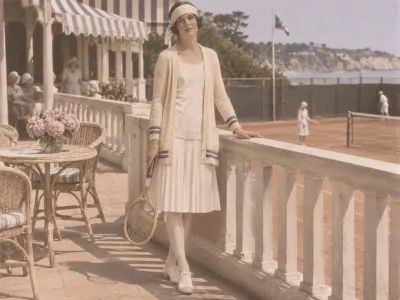
Chanel did not have the territory to herself. Jean Patou built his reputation on what the Palais Galliera calls "comfortable jersey sportswear ensembles," along with clothes for golf, tennis and swimming, sold from his boutique Le Coin des Sports. The museum's own Patou jacket of 1922, which appeared in Femina that June, is red and black wool cloth lined in white silk serge printed in black, with black ribbon criss-crossed at the collar, wrists and waist. His tennis clothes for Suzanne Lenglen, with their long cardigans, are in the 1930s tennis dress entry.
By the middle of the decade the sweater-and-skirt suit was everywhere, even at the House of Worth, the grandest name of the nineteenth century. Jean-Charles Worth's sketches in the V&A include "Marco" of early 1927, a brick-pink sweater over a pale pink skirt, and a run of similar sweater suits through 1928 and 1929. The skirts that went with them were usually straight or pleated, pleats giving the stride room that a straight tube at knee length could not.
The look was imitated at every level, sometimes cleverly. The Museum at FIT has a sportswear ensemble of about 1929: a grey wool top and cardigan, beret and scarf with navy and turquoise Art Deco wedges, and a navy wool crêpe gored skirt. The "knitted" pieces are not knitted at all. They are machine chain-stitch embroidery worked on a net backing to imitate wool jersey, the same method, FIT points out, as the hand-beaded evening dresses of the period. At home, women and girls simply knitted their own. The Viyella Knitting Book No 3, published between 1925 and 1930, has patterns for 71 garments, including a girl's jumper suit, a girl's cardigan and a sleeveless one.
Easy, unlined and comfortable, the cardigan suit set up two long careers. One ran through the British twinset of the 1930s to the 1950s sweater set. The other came back to Chanel herself, whose braid-trimmed tweed suits of the 1950s are the cardigan suit grown up.
Sources
- Gabrielle Chanel, Day Ensemble, c. 1928 - The Kyoto Costume Institute (Google Arts & Culture)
- "What makes Chanel so iconic?" - V&A
- Sports suit, ribbed silk and cotton, probably Britain, about 1918 (T.109:1&2-2025) - V&A Collections
- Jacket, Jean Patou, 1922 (GAL 1988.146.1) - Palais Galliera, musée de la Mode de Paris
- Jean-Charles Worth, 'Marco', fashion design, early 1927 (E.13142-1957) - V&A Collections
- Ensemble (cardigan, top, skirt, beret, scarf), wool knit and wool crepe, c. 1929 (2009.15.7) - The Museum at FIT
- 'Viyella Knitting Book No 3', William Hollins & Co Ltd, 1925-30 (MISC.1041-1992) - V&A Collections