The 1920s mid-to-late 1920s (named in 1922, at its height about 1924-1928)
The Garçonne Silhouette
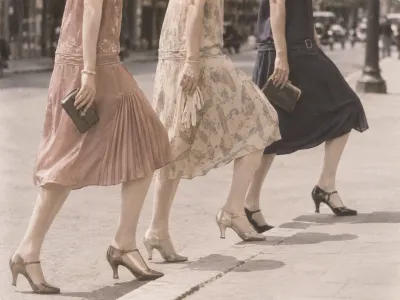
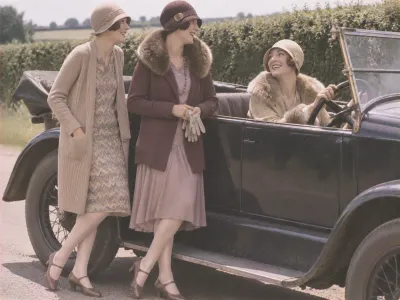
A straight tube from shoulder to hem, the bust flattened and the waist dropped to the hip: the boyish line named after a 1922 scandal novel, and the shape most people picture when they think of the 1920s.
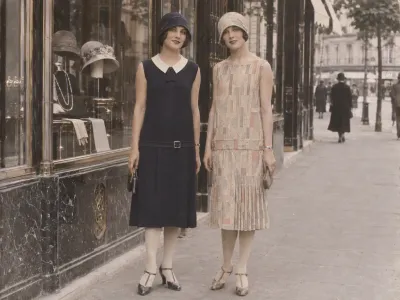
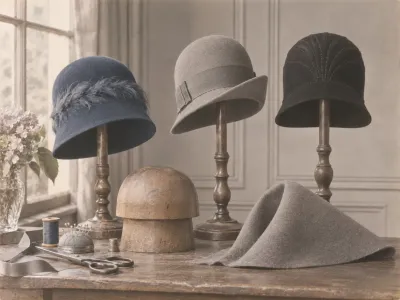
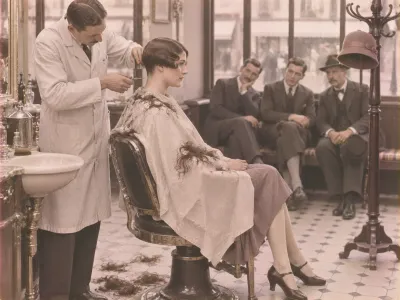
The name comes from a novel. Victor Margueritte's La Garçonne was published on 12 July 1922, the same day the French Senate refused women the vote, and its heroine, Monique, cuts her hair short, dresses like a boy, smokes, takes drugs and has affairs with women. Critics called it pornographic. The National Library of the Netherlands, which holds a copy, counts more than 150 articles about it within a year and sales of around 600,000, and the uproar cost Margueritte his Légion d'honneur. By 1925 Flammarion could sell a luxury edition, 778 copies with 28 stencil-coloured plates by Kees van Dongen, whose long, slim, short-haired women look exactly like the fashion plates of the same year. "Garçonne" became the French word for the look, roughly what English speakers meant by the flapper, and it went with the bob and the close little cloche.
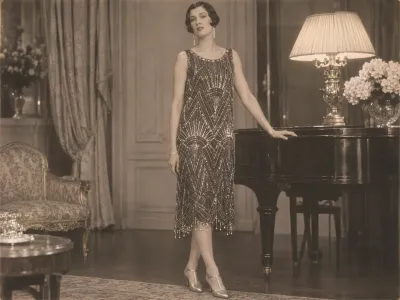
The silhouette itself is simple to describe. The V&A puts it in one sentence in its record for Poiret's 1924 satin dress "La Flute": drop-waisted dresses "hung from the shoulders in straight lines flattening out the contours of the bust." Where the loose chemise of the early 1920s still reached the calf, the garçonne version is shorter and flatter, and by about 1924 it had settled into a tube with the only horizontal line low on the hip. The measurements tell you how literal that tube was. A black satin evening dress of about 1925, probably from the Paris house of Myrbor and embroidered all over in silver and gold, measures 91 cm round the chest and 93 cm round the waist. The waist is bigger than the bust. As a dressmaker I find that number oddly thrilling, because it means there's no shaping at all: the fit happens at the shoulders and the rest simply falls.
The Paris houses made it their own. The V&A names Jean Patou and Chanel as leading exponents of the "garçon" look, with "smart, workmanlike and well-tailored clothes." Patou's evening dress "Byzance", from 1924, shows that workmanlike didn't mean plain: oyster georgette with a straight-cut bodice and low waist, beaded all over in pink, gold, bronze and imitation baroque pearls. Laid flat it is 42 cm across the hips. Under all that beading the cut is not much more complicated than a pillowcase, which is why the beaded evening dress became the decade's great showpiece.
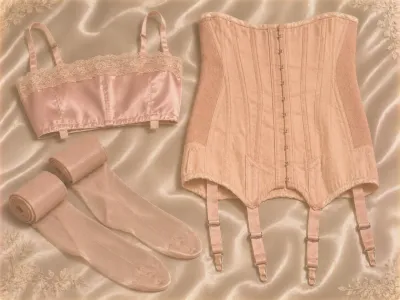
The trick is that the body underneath was not as free as the dress suggests. FIT's Fashion History Timeline puts it bluntly: the straight lines "looked best on bodies free from curves," and women who didn't have that body used exercise, diet and shaping underwear to get it. Two V&A brassieres show how. One, of about 1925, is black ribbed silk with elastic gussets at the back and a "corset stay" ending in an eye that hooked onto the corset below, so the flattened bust was anchored to the corset. The other, of about 1929, is a straight band of satin and lace with elastic tabs to attach it to the corset at the waist. So the Victorian corset hadn't vanished; it had moved down and changed its job, from pinching the waist to smoothing the hips. The bandeau and corselette entry follows those garments in detail.
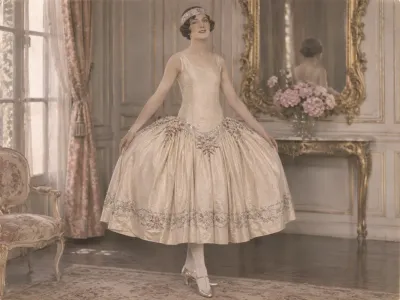
The pure garçonne line had a shorter life than its reputation. FIT notes that waistlines began to rise again in 1928, by which time hemlines had passed their shortest and were edging back down, and many women never wore the strictest version at all, preferring the full skirt of the robe de style. Within two years the waist was back where it belonged, a story told in the return of the natural waist.
Sources
- La garçonne (Victor Margueritte, illustrated by Kees van Dongen, Flammarion, 1925), Collection Anny & Antoine Louis Koopman - KB, National Library of the Netherlands
- Dress 'La Flute', Paul Poiret, 1924 (T.341-1974) - V&A Collections
- Evening dress, embroidered silk satin, probably Maison Myrbor, possibly designed by Natalia Goncharova, about 1925 (T.159-1967) - V&A Collections
- Evening dress 'Byzance', Jean Patou, 1924 (T.198-1970) - V&A Collections
- Brassiere, black ribbed silk, about 1925 (T.218-1973) - V&A Collections
- Brassiere, satin and machine lace, about 1929 (T.368-1976) - V&A Collections
- "1920-1929" - Fashion History Timeline, Fashion Institute of Technology