The 1920s early 1920s (about 1919-1924)
The Early-1920s Chemise
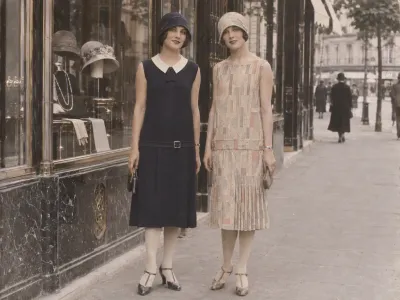
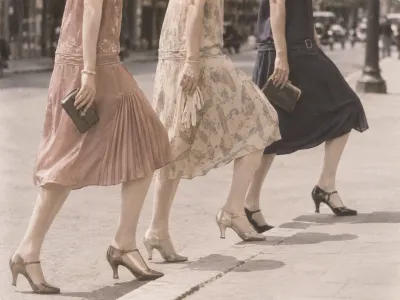
Loose, low-waisted and still long: the straight chemise dress of the early 1920s, hanging from the shoulders to the calf or ankle before the hem began its famous climb.

In 1919 the Hon. Mrs Anthony Henley went to the celebrations around the Paris Peace Conference in a dress by Chanel that is now in the V&A. It is a straight, sleeveless tunic of white chiffon over black net, with a round neck and wide vertical bands of beads and discs embroidered in a grape pattern, heavier towards the hem. There's no waist to speak of and no shaping to the body. Apart from its length, which is long, it is already the 1920s. That combination, the new straight line with the old long skirt, is what defines the first half of the decade.
The chemise of about 1919 to 1924 hangs from the shoulders like the undergarment it was named after. It is loose rather than tight, any waist marking sits low, and the hem is still at the calf or the ankle. The contrast with the late 1910s is the shift from two pieces to one. A ribbed silk sports suit of about 1918 in the V&A, sailor-collared and striped in purple and green, still has a loose jacket gathered into a waistband and a separate narrow skirt to the lower calf. In the chemise, jacket and skirt merge into one tube, and the eye is drawn down to the hip rather than in to the waist. The FIDM Museum's cotton lawn day dress of about 1923 shows how little cutting was left: a slim, straight column, sleeveless, shaped only by minimal bust darts, with a low, softly gathered waist that ignores the natural one entirely.
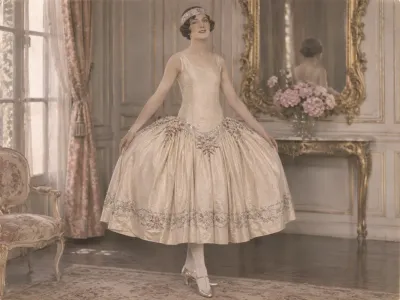
Length is what separates it from the later garçonne line, and length was argued over. The historian Pamela Parmal notes that between 1922 and 1924 designers actually tried to bring longer skirts back, and that many women protested, seeing shorter skirts as more youthful and modern. The museum pieces show the long version at its best. Chanel's black silk georgette evening dress, designed in 1922 for spring/summer 1923, is ankle-length, with a straight long bodice, stylised gold-thread and bugle-bead embroidery of the kind the Russian house of Kitmir worked exclusively for her, and silk drapes at the side over a skirt open from the knee. The V&A calls it a transition between the wide-skirted "picture dress" (the robe de style kept that idea alive) and the "Cubist" straight, square shape of the mid-1920s.
What I most enjoy about this silhouette is how little cutting it takes. Paul Poiret's day dress "Brique", whose photograph in the Paris fashion museum is inscribed February 1924, is a calf-length dress of orange flecked worsted whose body is cut in just two pieces, one front and one back, with dolman sleeves set in so low they almost reach the waist. Two panels below the hip form pockets and give a hint of fullness. The museum also notes that it is machine-stitched and hand-finished "in rather a crude manner," its wide hem bound with orange tape. If a couture dress could be put together that simply, a home sewer could certainly manage one, and the V&A has the proof in a 1920s black rayon overdress that it thinks "a good local or home dressmaker" made, decorated with rows of braid and bright red wooden buttons, used because ivory, bone and shell buttons had become scarce after the war. The straight cut and home dressmaking entry follows that story into paper patterns and the sewing room.
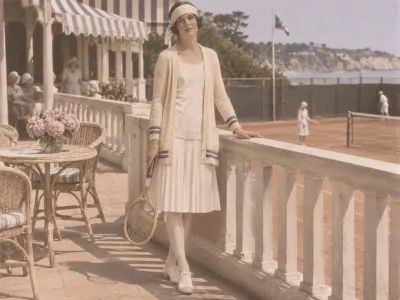
The long chemise didn't last. By 1925, Parmal records, skirts were ten to twelve inches off the floor, and the hemline kept rising for two more years. But the cut survived the change of length, and it came back under its own name more than thirty years later, when the sack dress of 1957 revived the unfitted chemise and shocked people all over again.
Sources
- Evening dress, white chiffon and black net, Coco Chanel, 1919, worn by the Hon. Mrs Anthony Henley (T.85&A-1974) - V&A Collections
- Evening dress, black silk georgette, Coco Chanel, spring/summer 1923 (T.86-1974) - V&A Collections
- Day dress 'Brique', Paul Poiret, 1924 (T.339-1974) - V&A Collections
- Sports suit, ribbed silk, about 1918 (T.109:1&2-2025) - V&A Collections
- Dress, black satin and rayon with wooden buttons, probably home-made, 1920s (T.273&A-1988) - V&A Collections
- Embroidered cotton lawn dress, about 1923 (2000.219.2) - ASU FIDM Museum
- Pamela A. Parmal, "Hemlines", Encyclopedia of Clothing and Fashion - Encyclopedia.com