The 1920s throughout the 1920s (from about 1921)
The Sportswear Silhouette
Pleated skirts, jersey and cardigans: how clothes made for tennis, golf and the beach became what fashionable women wore every day, led by Patou and Chanel.
In June 1922 the French magazine Femina published a jacket by Jean Patou that is now in the Palais Galliera in Paris: a loose paletot of red and black wool cloth, criss-crossed with black ribbon at the collar, the wrists and the waist, and lined in printed white silk serge. It is a town jacket, not a games kit, but you can see the playing field in it: the easy cut, the bold colour, the sense that the wearer might need to move. That is the sportswear silhouette in brief. For most of the 1920s the clothes fashionable women wore to lunch were designed as if they were about to play eighteen holes.
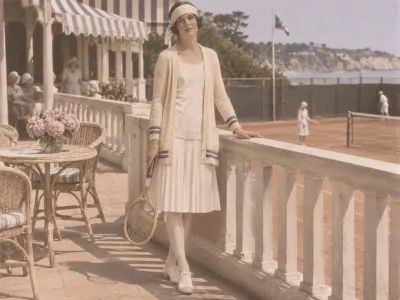
The model for all of it was tennis. Suzanne Lenglen's appearances in Patou's clothes from 1921 are told in the 1930s Patou entry and the tennis dress; FIT's Special Collections sum up why they mattered: her ensembles "challenged traditional tennis attire by way of shorter skirts and bare shoulders," and she licensed them to American manufacturers, so the look spread far beyond those who saw her play. Even her underwear made the trade press: in 1926 Women's Wear Daily described the narrow, one-piece step-in she wore beneath. Patou wasn't alone. Jeanne Lanvin, the house of the romantic robe de style, launched a dedicated sports department in 1923.
The other root was Chanel and jersey. The V&A's record for a ribbed silk sports suit of about 1918 explains the move: she repurposed wool and silk jerseys "otherwise generally used for male undergarments and stockings" for everyday jackets and blouses, and the loose shapes were so well suited to ready-to-wear that department stores turned out copies in artificial silk. She took production into her own hands, too: in the early 1920s her silk-enriched wool and cotton jerseys were being made at Asnières-sur-Seine under the name Tricots Chanel. By 1924 sport was fashionable enough to be a ballet. Le Train Bleu, staged by the Ballets Russes that year, was all flirtation, bathing, golf and tennis on a beach in the south of France, in costumes by Chanel. The V&A has the one Lydia Sokolova wore as the bathing belle La Perlouse: a cyclamen-pink, hand-knitted wool one-piece with a short overskirt and attached shorts, banded in black and white. Sokolova remembered that the little suede skull cap made for her "set a fashion."
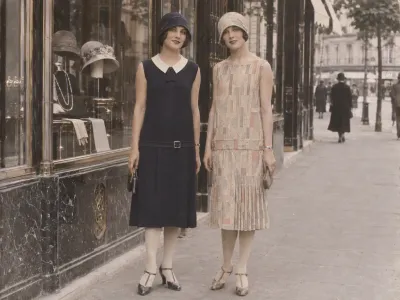
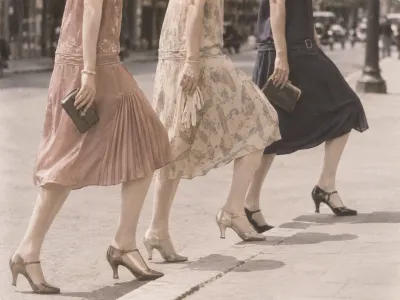
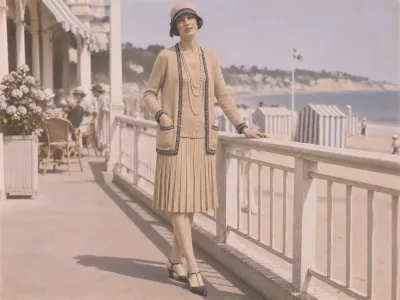
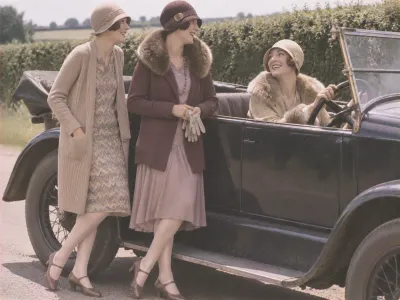
The everyday version was a set of separates. FIT's Fashion History Timeline uses a Patou ensemble of about 1927 in the Met, a yellow skirt and sweater, to show "how much tennis clothes influenced design." A pleated skirt with a jumper or long cardigan over it became a uniform for day, and the cardigan suit made it smart enough for town. What strikes me as a maker is how forgiving those clothes were to fit. Knit stretches, pleats open, and a hip-length sweater hides the waist the straight line didn't want anyway. By 1928 The Tatler could report that sports clothes were worn "until the hour of cocktail."
Patou put all this under one roof. His boutique, Le Coin des Sports, at his couture house at 7 rue Saint-Florentin, sold jersey sportswear ensembles, golf and tennis clothes and swimsuits, and the Palais Galliera credits those clothes with building its reputation. The opening year is usually given as 1925, though neither the Galliera nor the Universalis account gives a date, so it is best treated as approximate. The Encyclopædia Universalis adds that the American mannequins he brought to Paris (recruited in New York, they made their debut in 1925) made the front pages with their energy and good looks, which put the athletic body itself on show in the salon. That active ideal carried straight on into the 1930s, with shorts, sunbathing and the swimsuit, and the habit of a sweater worn with its matching cardigan led on to the sweater set of the 1950s.
Sources
- Jacket (paletot), Jean Patou, 1922 (GAL 1988.146.1) - Palais Galliera, musée de la Mode de Paris
- "Tennis in the '20s" - Material Mode, FIT Special Collections and College Archives blog, 2015
- Sports suit, ribbed silk, about 1918 (T.109:1&2-2025) - V&A Collections
- Dress fabric stamped 'Tricot Chanel', about 1928-29 (T.193-1975) - V&A Collections
- Costume for La Perlouse in Le Train Bleu, Coco Chanel, 1924 (S.836-1980) - V&A Collections
- "1920-1929" - Fashion History Timeline, Fashion Institute of Technology
- "Patou Jean" - Encyclopædia Universalis