The 1920s from 1921 to the end of the decade
Knife Pleats and the Pleated Skirt
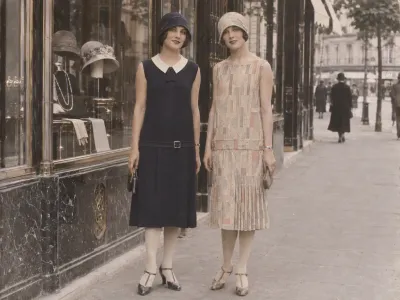
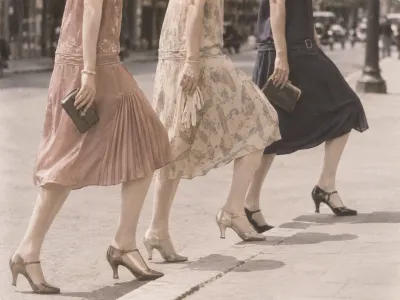
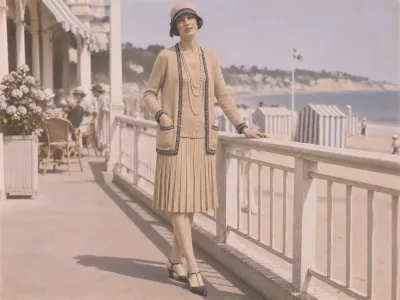
Pleats gave a knee-length tube skirt room to stride, play tennis and dance, but in wool, silk and cotton they had to be basted, pressed and set again after every wash.
Peggy Joyce of London E8 was about six when she wore a little cotton dress, printed with a grey and brown check on cream, that later came to the V&A as a bequest. It has a round neck, short sleeves, a collar, cuffs and belt in terracotta cotton, a patch pocket, and a skirt attached to the slightly dropped waist in box pleats. The catalogue notes that the pleats are unpressed. On a child's washable cotton, that makes sense: unpressed pleats hang in soft folds and survive the tub, and pressed ones would have had to be set again every washday. That difference, between a pleat that is folded and a pleat that is fixed, runs through the whole decade.
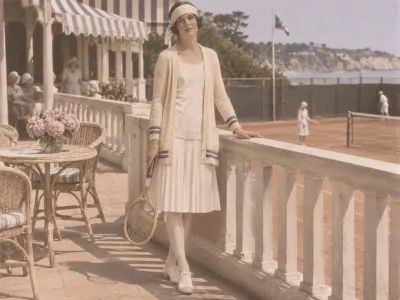
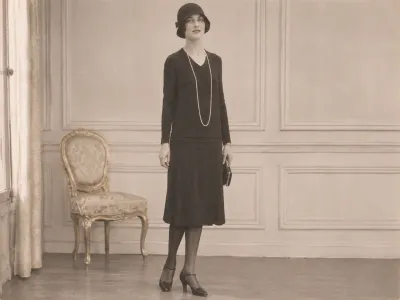
Pleats solved the central problem of the 1920s skirt. A straight tube that stops at the knee has no room for a stride, let alone a backhand. Pleats lie closed while the wearer stands, keeping the narrow line, and open when she moves. Tennis made the case. At Wimbledon in 1921 Suzanne Lenglen played, dressed by Jean Patou, in a white pleated silk skirt that skimmed her knees, and Patou went on to pair striped sweaters with box-pleated skirts, which Vogue featured again and again. That became the uniform of the sportswear silhouette. Knife pleats all fold the same way, each lying over the next, so the skirt keeps a flat, directional surface; box pleats turn two folds away from each other, and their reverse, the inverted pleat, hides the fullness behind a flat front.
Women made them too. In 1926 a British woman, Hepburne Scott, designed, made and played in a white linen tennis dress with a pleated front to its skirt, flat folds falling from a belt at the hip, trimmed with squares of green linen. She told the V&A she lengthened it later in the decade, the story of the 1930s tennis dress in miniature. Couture used pleats more slyly, as panels let in low on the tube. A Boué Soeurs day dress of 1925 has whitework panels with pleated tulle inserts on either side of the skirt, and a summer outfit of about 1928, possibly by Lanvin, has a straight-cut skirt with a plain panel front and back and pleating only at the sides, where the eye doesn't go. One of Chanel's black dresses of about 1926, described under the little black dress, ends the same way, in a knife-pleated lower skirt.
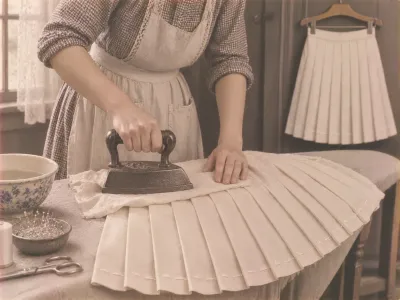
The pleats themselves were set by hand, heat and patience. The New Butterick Dressmaker of 1927 tells the home sewer to lay the pleats "before the seams are joined", to keep them even "without any draw, especially when the edges come bias", to baste each "a little distance from the fold edge", stitch them with one seam left open, and press. Then came washing, which undid it all. Wool, silk, cotton and rayon hold a pressed fold only until water relaxes it, so the manual's laundering chapter advises running a thread across the pleats near the hem and every six inches above before the skirt goes in the tub, then pinning it inside out to the ironing board and pressing again, with an iron that is not too hot for silk. As a maker I find that advice oddly moving: every pleated tennis skirt of the decade came with a standing appointment at the ironing board.
The exception was expensive and older. The Venetian "Delphos" dress used a pleating process patented in 1909, which the V&A now credits to Henriette Nigrin rather than Mariano Fortuny alone, with narrow widths of finely pleated silk hand-sewn into a tube. It was a tea gown for the rich, not a tennis skirt. Pleats that really survived the wash had to wait for nylon, and for the heat-set permanent press that put pleats into skirts in the 1960s, described in synthetic-blend easy-care construction.
Sources
- Girl's dress, printed cotton with box-pleated skirt, British, c.1928 (B.952-1993) - V&A Collections
- Amy de la Haye, "Patou, Jean", Encyclopedia of Clothing and Fashion - Encyclopedia.com
- Tennis dress, linen, designed, made and worn by Hepburne Scott, 1926 (T.260-1976) - V&A Collections
- Day dress with whitework panels and pleated tulle inserts, Boué Soeurs, Paris, 1925 (T.395-1989) - V&A Collections
- Summer day outfit of silk crêpe, possibly Jeanne Lanvin, ca. 1928 (T.142 to C-1967) - V&A Collections
- The New Butterick Dressmaker (Butterick Publishing Company, 1927) - Internet Archive
- 'Delphos' dress, pleated silk satin, Henriette Nigrin with Mariano Fortuny, Venice, ca. 1920 (T.423&A-1976) - V&A Collections