The 1920s throughout the 1920s
Jersey
A knitted fabric once kept for underwear and sport, which Chanel made fashionable from 1916. Its stretch and easy hang suited the loose, uncorseted line of the 1920s.
In 1924 the Ballets Russes staged Le Train Bleu, a ballet about flirting on a fashionable beach, with costumes by Gabrielle Chanel. The V&A has one of them: a royal blue bathing costume for one of the male chorus, machine-knitted in wool jersey with a little overskirt and attached shorts. The two leading dancers had hand-knitted versions. Lydia Sokolova, who wore the pink one, remembered that her partner had to throw her in the air and catch her, and that "my woollen costume was impossible to grip". A couturier dressing a ballet in what was basically sportswear shows where jersey stood by the mid-1920s.
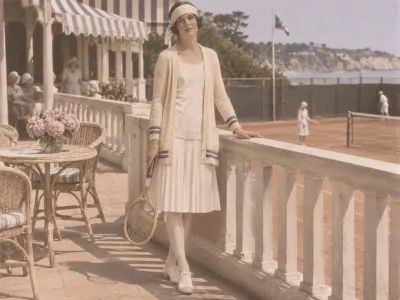
Jersey is a knit, not a weave. In plain jersey each loop of yarn is drawn through the loop below it, which gives neat vertical wales on the face and crosswise rows on the back. The Encyclopedia of Clothing and Fashion traces the name to the island of Jersey and its fishermen's knits, and notes that Lillie Langtry, "the Jersey Lily", wore a fashionable jersey top as early as 1879. Even so, the V&A points out that before Chanel took it up, plain silk jersey had mostly been used for men's sportswear and underwear. Tennis, cycling and golf had already put women into shorter skirts and jackets of tweed or knitted jersey by the end of the nineteenth century, and the museum's sports suit of about 1918 has striped silk jersey trimming on its sailor collar and cuffs.
Chanel's step was to make it the fabric of fashionable daywear. Amy de la Haye records that in 1916 she bought a stock of surplus jersey from the textile manufacturer Rodier and made it into unstructured three-quarter-length coats, belted at the waist and trimmed with fur or rich fabrics, worn with matching skirts. A 1915 report in the New York Herald Tribune, quoted by the V&A, had already noticed "the Chanel silk jersey suits which were to be seen in such profusion at Deauville", and Vogue called the liking for jersey "a veritable craze". How much of the surplus-stock story is polish is hard to say, since Chanel shaped her own legend (see the 1930s Chanel entry), but her name and the fabric were linked from the start. As early as October 1917, British Vogue, quoted by de la Haye, said the house "might be called the 'Jersey House'".
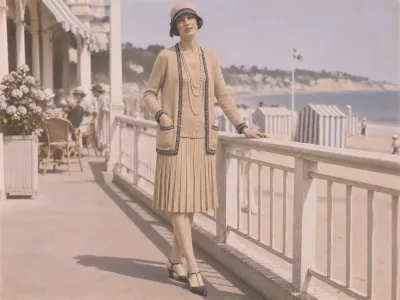
In the 1920s she took control of supply. The V&A says that early in the decade she opened a factory at Asnières-sur-Seine to make her own silk-enriched wool and cotton jerseys, exclusive to her. It traded as Tricots Chanel until around 1929, when it became Tissus Chanel and branched into printed silks and woven cloth; the museum's printed woven wool and silk of about 1928 is still stamped "Tricots Chanel" on the selvedge. Vogue was recommending a Chanel jersey suit in soft tan wool as late as 1927, and the knitted cardigan suit became one of the decade's uniforms.
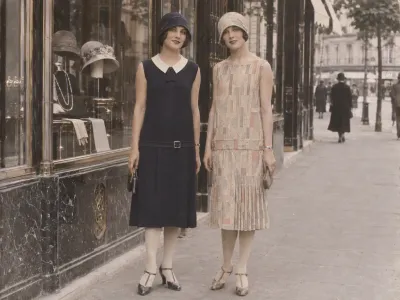
Why did it suit the period? The sportswear line of the 1920s was loose, straight and worn without a rigid corset, and jersey needs very little fitting to look right on the body. It stretches more across than along its length, so a plain tube eases over the hips and shoulders without darts. The catch is that it curls at a cut edge, can run, and grows if hung. When I sew jersey I cut with the wales running straight down the body, stay the shoulders and neckline with tape, use a stitch that can stretch, and press very lightly so the loops don't flatten.
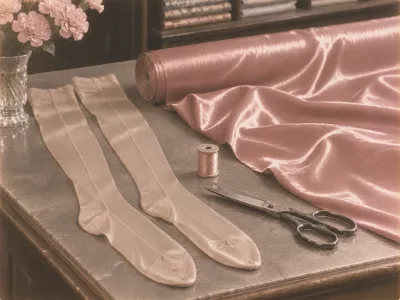
Knits didn't leave the underwear drawer, though. The V&A's knitted rayon combinations of the 1920s, made by An-On, show the same kind of fabric being spun from artificial silk for lingerie. Jersey's move into evening dress, cut on the bias and draped, came later and is covered in the 1970s jersey entry.
Sources
- "Jersey", Encyclopedia of Clothing and Fashion - Encyclopedia.com
- Amy de la Haye, "Chanel, Gabrielle (Coco)", Encyclopedia of Clothing and Fashion - Encyclopedia.com
- "Gabrielle Chanel: dressing the modern woman" - Victoria and Albert Museum
- Costume for a 'Gigolo' in Le Train Bleu, machine-knitted wool jersey, Gabrielle Chanel for the Ballets Russes, 1924 (S.837-1980) - V&A Collections
- Dress fabric of printed wool and silk, Tricots Chanel, Asnières-sur-Seine, ca. 1928 (T.193-1975) - V&A Collections
- Jacket and skirt ensemble for sport or informal daywear, ribbed silk and cotton with silk jersey trimming, about 1918 (T.109:1&2-2025) - V&A Collections
- Women's combinations in knitted rayon, An-On, Great Britain, 1920-1929 (T.349-1996) - V&A Collections