The 1920s throughout the 1920s
The Bandeau and the Corselette
What went under the straight line: bust-flattening bandeaux, light elastic girdles and the all-in-one corselette, and the first bras with cups that pushed back against the boyish form.
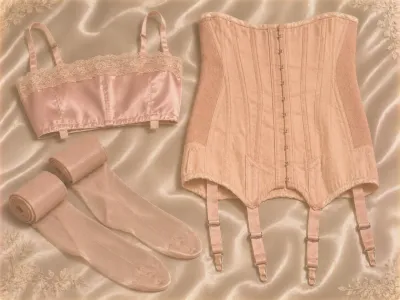
Around 1929 a British mother made her daughter a bandeau, and the daughter later gave it to the V&A. It is a straight band of pale pink silk satin with a top of machine-made ecru lace, a few tucks, hooks and eyes at the back and pink satin shoulder straps. At the hem are elastic tabs with hooks, so it could be fastened to a long, slim corset below. There are no cups and no shaping beyond the tucks, and that was the point: the museum's label says its almost tubular shape was designed to flatten the bust, the first requirement of the garçonne silhouette.
The bandeau was the decade's basic bra, an exercise in compression. The Underpinnings Museum's 1920s chapter starts with Nemo's "Circlet", a wraparound bandeau patented in 1919 in cotton bobbinet tulle and twill, made to compress and streamline the bust. Its maker, Kops Brothers, had to change its machinery when underwear went light, to handle sheer fabrics, lace and ribbon, and cheaper artificial silk came in alongside real silk. Elastic arrived at the back so a bra could move with an active body. Early elastic was a rubber core wrapped in fabric, though, and it rotted: a rayon satin bandeau by The Modishform in the same collection has elastic panels that are now brittle. The pink bandeau's tabs show the other answer: anchor the bra to the corset, so the bust was held flat from below.
So the corset hadn't gone. The dress historian Jane Farrell-Beck writes that young women generally rejected their mothers' heavy corsets, and that the most fashionable wore only a bandeau, step-in knickers and rolled stockings. But by the mid-1920s most accepted a garter belt or a light girdle: waist to hip, in white or peach knitted elastic, worn over the step-ins and costing from about $1 to $6. A department-store buyer quoted by the J. Walter Thompson advertising agency put it bluntly: the "widely talked of abandon of corsets was a myth." Even flappers, the buyer said, wore "a garter belt or corselette." The corselette joined bra and girdle in one, smoothing a woman from bust to thigh in a single straight line. The Met has one made by the Royal Worcester Corset Company in 1924-25, in cotton with bone, metal and elastic. Compared with the Victorian corset it had a new job: not pinching a waist but erasing one.
The push back towards shape started in a dressmaker's shop. In 1922 Ida Rosenthal and Enid Bissett were running Enid Frocks on West 57th Street in Manhattan. Their cheapest dress cost $125, Rosenthal later said, "and it just didn't fit right" over the "flat things like bandages" their clients wore, so they made "a little bra with two pockets". Her husband William improved it with an elastic centre, and they named it Maiden Form against the "boyish form" then in vogue. It's the company's own story, told long afterwards, but the paper trail fits: the business was incorporated in 1925 as the Enid Manufacturing Company and began making bras in Bayonne, New Jersey, in 1926. In London the Kestos bra, two overlapping triangular cups with shoulder straps and elasticated ties that fastened at the front, offered support and lift without bulk. Its dates are muddled. One V&A label has Rosamond Klin experimenting with two folded handkerchiefs in 1926; another says Rosamond Kennedy patented it in 1928; the Underpinnings Museum gives the patent as 1926.
As a dressmaker I like how small these steps were: a pair of pockets, two triangles, a strip of elastic. Separate cups, which the Underpinnings Museum dates to the late 1920s, and Lastex elastic yarn, patented at the start of the 1930s, finished the bandeau, and once the waist rose again they led straight to the roll-on girdle and to the lettered sizes of the uplift bra.
Sources
- "Lift & Separate", Chapter 2: 1920s - rayon, elastic and patents - The Underpinnings Museum
- Bandeau, pale pink silk satin with machine-made lace, Britain, about 1929 (T.368-1976) - V&A Collections
- Jane Farrell-Beck, "Girdle", Encyclopedia of Clothing and Fashion (2005) - Encyclopedia.com
- Corselet, Royal Worcester Corset Company, 1924-25 (2009.300.6664) - The Metropolitan Museum of Art
- "Maidenform, Inc.", International Directory of Company Histories - Encyclopedia.com
- "Lift & Separate", Chapter 3: 1930s - The Underpinnings Museum
- Brassiere styled like the Kestos, embroidered silk, Britain, 1930s (T.789-1995) - V&A Collections