The 1930s early-to-late 1930s
Lastex and the Elastic Revolution
An elastic yarn made from a fine rubber core wrapped in cotton, silk, or rayon - the quiet innovation behind clinging swimsuits, two-way-stretch girdles, and the end of the rigid corset.
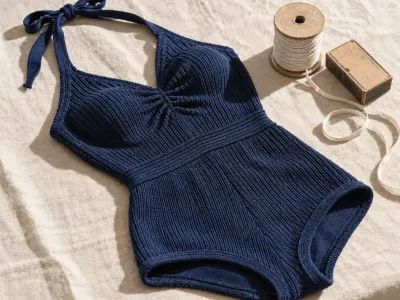
Lastex doesn't sound very glamorous, but it's one of the most important fabric innovations of the 1930s. Developed in the United States in the early 1930s, it was an elastic yarn made from a very fine core of extruded rubber wrapped in textile fibres - cotton, silk, rayon, or wool. Earlier elastic had used thicker rubber threads, which were bulky and limited in how they could be used. Lastex was fine enough to be woven or knitted into fabric, which meant a whole garment could be made stretchy.
That changed two categories of clothing in particular. The first was swimwear. A swimsuit knitted with Lastex could cling closely to the body and keep its shape, even when wet, which made possible the sleek, figure-hugging maillot that took over the decade's beaches. The second was foundation garments. With stretch fabrics, girdles and corsets no longer needed to rely on heavy boning and lacing to shape the body - a Lastex girdle could smooth and control the figure while moving with it, leading to the two-way-stretch girdle and the roll-on. Bras benefited too, with elastic panels and straps that fitted better and stayed in place.
What I love about Lastex is that it shows how much of fashion history is really technology history. The fluid, body-conscious clothes of the 1930s needed smooth, flexible underwear beneath them, and elastic yarns made that possible. It's also why the rubber shortage of the Second World War hit so hard: by the 1940s, women had come to depend on stretch in their underwear, and losing it meant going back to older methods - a story told in the 1940s girdle entry.