The 1930s throughout the 1930s
The Roll-On Girdle and the End of the Corset
Elastic girdles that could be pulled on without laces or hooks replaced the boned corset for most women - smoothing the hips for bias-cut dresses while letting the body move.
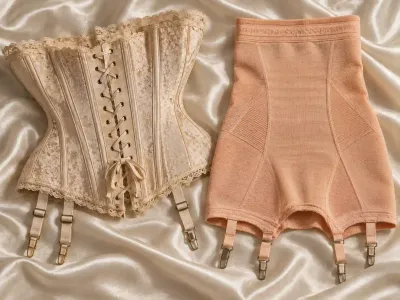
The bias-cut and fluid, clinging fashions of the 1930s showed every line of what was worn underneath. A traditional boned corset, with its ridges, laces, and hooks, simply didn't work under a satin gown - and for most women, the decade's answer was the elastic girdle. It aimed for a smooth, continuous line from waist to thigh rather than a dramatically reshaped figure.
The key garment was the roll-on: a tube-shaped girdle made of elastic fabric with no fastenings, which the wearer rolled or pulled on over the hips. Other girdles used elastic panels combined with woven fabric, sometimes with a little light boning or a side hook-and-eye closure, and often with suspenders attached to hold up stockings. The new Lastex yarns made "two-way stretch" girdles possible - fabric that stretched both lengthwise and crosswise - which moved with the body far better than earlier elastic. Combined with the newly shaped bra, or with a one-piece corselette that joined bra and girdle together, this was the foundation of the decade's look.
I think this is one of the most important shifts in the history of women's underwear. The rigid corset had dominated women's dress for centuries, and the 1920s had already loosened its grip, but the 1930s elastic girdle is where controlling the figure without confining it really became normal. Corsets didn't disappear completely - they came back briefly in the 1939 nipped-waist silhouette, and again after the war - but for everyday life, stretch had won. That dependence on elastic is exactly why the 1940s rubber shortage was such a problem.