The 1930s late 1930s (1937-1939)
The 1939 Nipped-Waist Silhouette
A sharply cinched waist, fuller and shorter skirts, and the return of the corset in Paris's last pre-war collections - a preview of the New Look that the war postponed by eight years.
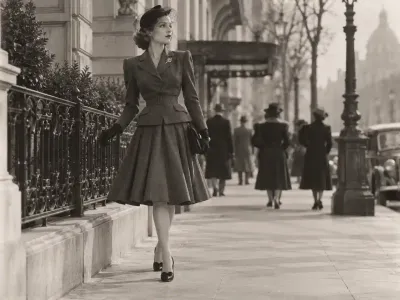
One of my favourite "what if" moments in fashion history happens at the very end of this decade. In 1938 and 1939, Paris couture began showing something that looks remarkably like Dior's 1947 New Look: a tightly cinched waist, fuller skirts, and a revived interest in the corset. Then the war began in September 1939, and that silhouette was put on hold for most of the next decade.
The best-known image of this moment is Horst P. Horst's 1939 photograph for Vogue of a model from behind, wearing a laced corset made by Detolle for Mainbocher - a shot Horst later remembered as the last photograph he took in Paris before the war. It's a strange, beautiful, slightly unsettling picture, and it captures how the late-1930s silhouette was pulling away from the soft, unstructured bias-cut look of earlier years and back toward shaping the body with structure. Skirts got shorter, rising toward the knee, and fuller, sometimes gathered or pleated, with the broad shoulders of the mid-decade still in place above the newly narrowed waist.
It's easy to read too much into this in hindsight, but I do think it's worth knowing about, because it changes how the New Look should be understood. Dior didn't invent the nipped waist and full skirt out of nowhere in 1947. He picked up a line that Paris had already been drawing just before the war, and pushed it further than anyone had dared. The war years in between, with their square shoulders and short, skimpy utility skirts, are almost an interruption of a story that was already underway - and the 1940s postwar softening is really the moment it resumes.