The 1970s 1970s
Elastic Waistbands and Easy-Care Construction
Comfort becomes a real ready-to-wear selling point - elasticized waists, pull-on construction, and a shift away from fitted waistbands built around a zipper and a hook-and-eye.
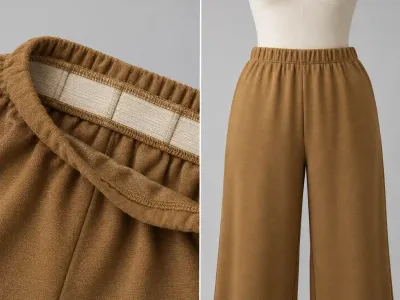
A fitted waistband through the 1950s and into the '60s was, construction-wise, a fairly involved piece of engineering - a stiffened band, usually interfaced with a woven fusible or sew-in canvas to keep its shape, closed with a side or back zipper and often a hook-and-eye or button above it for the last half-inch of closure, sized to one specific waist measurement with essentially no give. Sizing errors, weight fluctuation, or simply wanting to eat a big meal without discomfort were the garment's problem to solve badly, not the wearer's to solve at all. The elasticized waistband that becomes genuinely common through this decade is a direct construction answer to that rigidity, and it's worth being specific about how it actually gets built rather than treating "elastic waist" as a single undifferentiated idea.
The simplest version is a self-fabric casing - a folded-over band of the garment's own material stitched down with a gap left open, elastic threaded through and its ends overlapped and stitched, the gap then closed - which is cheap, forgiving of fit, and became a default on casual trousers, skirts, and a huge share of children's and loungewear through the decade. A more tailored variant, sometimes called an "action waist" or "comfort waist" in period pattern catalogs and ready-to-wear marketing, kept a shaped, interfaced waistband on the outside for a fitted look while inserting elastic only at the back or sides, giving several inches of stretch exactly where the body needed it most without sacrificing the tailored front a woman might want for office wear. Both versions leaned hard on polyester double knit's actual mechanical properties to work well at all - polyester and double knit fabric has real stretch recovery, snapping back to its original shape rather than sagging out the way a natural-fiber woven would, which meant an elasticized polyester waistband held its shape wash after wash in a way that would have looked defeated in cotton or wool within a season.
I don't think it's an exaggeration to call this a genuine ready-to-wear values shift, not just a construction footnote. Comfort had rarely been treated as a first-order design goal in mainstream women's clothing before this decade - fit and silhouette usually won any conflict with ease of movement - and the sheer volume of elasticized, pull-on, easy-care separates moving through catalogs and department stores by the mid-1970s is a real sign that manufacturers had concluded comfort could sell on its own merits, not just as a concession for maternity or plus-size lines where it had traditionally been quietly confined. That's a bigger deal than the waistband itself.