The 1970s 1970s
Polyester and Double Knit
The decade's most mocked-in-hindsight fabric was also its most genuinely liberating - wash-and-wear synthetics that freed working women from the ironing board.
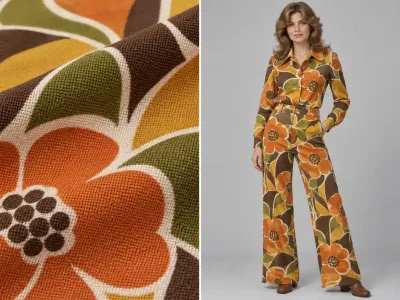
I have to defend polyester double knit a little before I criticize it, because the "leisure suit punchline" version of this fabric obscures a genuinely practical story. A double-knit polyester garment could be machine washed, tumble dried, and worn again within the hour with no iron in sight - and for a woman who was, by mid-decade, increasingly likely to also be holding down a job outside the house, that wasn't a trivial convenience. It was closer to the same "easy-care" argument nylon had made a generation earlier, just pushed further, into heavier garments that used to demand real upkeep - suits, dresses, trousers, not just stockings and blouses.
Double knit specifically refers to the construction, not just the fiber: two sets of needles knitting simultaneously to produce a thicker, more stable fabric with almost no stretch distortion and very little tendency to run or ladder, which made it genuinely well-suited to tailored-looking garments that still had knit-level comfort and forgiveness. Combined with polyester's total resistance to wrinkling, it became the default fabric for an enormous range of ready-to-wear through the decade - loud florals and geometric prints especially, since polyester took dye extremely well and held color better than natural fibers under repeated washing. It's also genuinely tied to the decade's economics: the 1973 oil embargo hit petroleum-derived synthetics' input costs directly, at the same moment cotton and wool prices were also climbing, which pushed manufacturers and consumers alike further into synthetics rather than away from them, at least through the mid-decade crunch.
The reputation collapse came later, in the '80s and beyond, once "polyester" became shorthand for cheap and dated - but that's a retrospective judgment the fabric didn't earn in real time. Through the '70s it was aspirational in its own way: modern, low-maintenance, printable in bold new colors natural fibers couldn't always hold as well, and directly enabling the era's growing interest in elastic waistbands and comfort-first construction. I think that's the throughline worth keeping in mind whenever you see a decade-defining polyester print dismissed as kitsch - it was, at the time, a real answer to a real domestic-labor problem, not just a fashion mistake waiting to be laughed at later.