The 1970s 1970s
Closures: Snaps and Zips in Unstructured Clothing
As garments loosened and knits got stretchier, closures got simpler too - snaps, minimal zips, and self-ties replacing the heavy boned-and-zipped fastenings of the 1950s.
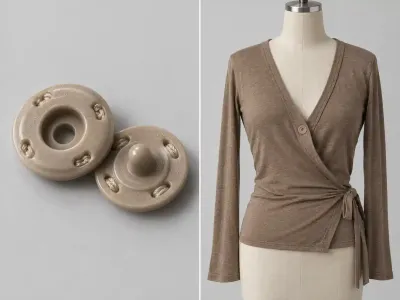
Closures are a genuinely underrated way to read a decade's construction values, because they're one of the few construction elements that gets touched by the wearer every single time the garment goes on. A 1950s fitted dress typically needed a long back or side metal zipper, often a full 20-22 inches, installed by hand-basting and machine-stitching close alongside a boned or heavily interfaced bodice seam - a genuinely fussy, skilled step in the garment's construction, and one that assumed the wearer either had help getting dressed or real patience doing it alone. By the back half of the 1970s, a lot of ready-to-wear simply doesn't need that level of engineering anymore, and the closures used across the decade's most popular garments are noticeably simpler as a direct consequence.
The clearest case is the wrap dress, which needs essentially no traditional closure hardware at all - no zipper, no buttons, just a self-fabric tie belt cinching the overlapped front panels shut, a construction choice that's as much about ease of wear as it is about flattering fit across body sizes without a fixed measurement. Snaps do a lot of the remaining work through the decade on shirts, jackets, and denim - cheaper and faster to apply by machine than a buttonhole, forgiving of a slightly-off placement in a way a bound buttonhole isn't, and genuinely well suited to knit and double-knit fabrics where a stiff button placket can fight the fabric's natural stretch. And a real share of the decade's knit tops, ponchos, and pull-on trousers in polyester and double knit skip closures entirely, relying on the fabric's own stretch to get over the head or hips with no opening at all - something that would have been unthinkable in a woven fabric a generation earlier.
None of this is an accident of taste so much as a knock-on effect of everything else this decade's construction section covers - once a garment isn't built around a rigid foundation or a precisely fitted seam, it simply doesn't need the heavy-duty closure that fitted, structured garment required to stay on the body correctly. I think that's the real thread connecting a wrap dress's tie belt to a snap-front western shirt to a pull-on knit poncho: closures got lighter because everything upstream of them - the cut, the fabric, the whole idea of what "fitted" meant - had already gotten lighter first.