The 1960s mid-1960s
The Zip-Front Dress and Side-Zip Closures
Moving a dress's zipper from the center back to the front or side - a small placement change that meant a woman could actually get dressed and undressed without needing a second pair of hands.
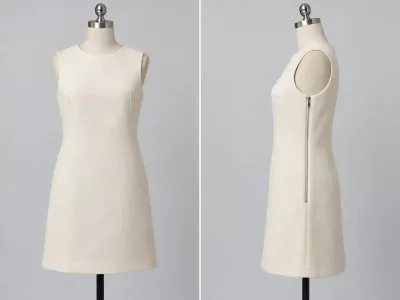
For decades before this one, a fitted dress's zipper almost always ran up the center back - a closure position that works fine visually but creates a genuinely awkward practical problem: a woman getting dressed alone has to reach behind and above her own shoulder blades to close it, which is difficult or outright impossible depending on the garment's fit and her own flexibility. Moving that same zipper to the front, or more commonly to one side seam, solves the problem directly - a side or front closure is fully reachable and visible while dressing, no assistance or awkward contortion required.
This shift lines up naturally with the shift dress's broader simplification of construction generally - a garment already built with minimal shaping and no waist seam gains little from a traditionally placed back closure, and a side zip integrates cleanly into the shift's straight side seam without disrupting its clean lines the way a front zip sometimes could. It's a genuinely practical construction choice that happened to also suit the decade's growing taste for unfussy, quickly-worn clothing.
I think this closure change is worth treating as its own construction entry because it's a clear, concrete example of garment engineering responding directly to a real daily-life problem rather than pure style preference - the mod silhouette's young, busy, increasingly independent wearer needed to get dressed quickly and alone, and a dress that required someone else's help to close simply didn't fit that daily reality anymore. Small as it seems, this is exactly the kind of construction detail that reveals how much a garment's engineering can be shaped by who's expected to be wearing, and closing, it without assistance.