The 1970s mid-1970s
The Wrap Dress
A printed jersey dress that ties shut instead of zipping - deceptively simple construction that became one of the decade's genuine commercial phenomena.
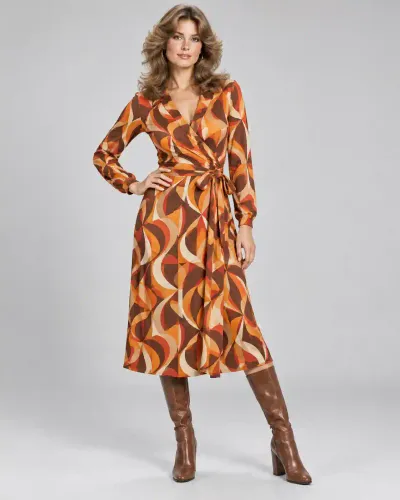
I keep coming back to how little is actually happening in a wrap dress, construction-wise, because that's the whole point of it. No zipper, no buttons, no hidden hook-and-eye at the waist - just a bodice and skirt cut in one continuous wrap, closed with a self-fabric belt that ties at the waist and does all the shaping work a boned foundation used to do. Diane von Furstenberg put it into mass production starting in 1974, and the dress that resulted is genuinely one of the most efficient pieces of garment engineering the decade produced.
The construction is worth walking through because it explains the fit as much as the fashion history does. A wrap dress is cut so the front closes at an angle, one side crossing over the other and tying at the side seam, which means the exact fit adjusts to the wearer rather than being locked into a fixed size the way a zip-back dress is - tie it slightly looser or tighter and the dress genuinely moves with you. That's not a small thing for a garment meant to survive a full workday and then go straight to dinner without a change of clothes, which was explicitly how DVF marketed it. It only works, though, because of the fabric underneath: printed jersey has enough stretch and drape to cling without a rigid interior structure holding the shape, which is exactly the kind of soft, body-skimming fit the broader wrap silhouette is built around.
What makes the wrap dress worth an entry of its own, beyond the silhouette it belongs to, is how directly the construction answers a real mid-decade problem: women entering white-collar jobs in growing numbers needed clothes that read as professional without requiring a wardrobe change for evening, and that could be put on and taken off without help - a genuinely practical concern for anyone living alone or simply in a hurry. A dress with no zipper to reach behind your own back, that adjusts to a changing body without alteration, and that photographs as put-together rather than casual, solved several problems in one piece of fabric. That combination of practicality and glamour, more than any single print or color, is why it sold in the millions rather than staying a novelty.