The 1970s 1973-1976
The Energy Crisis and Fashion
The 1973 oil embargo made petroleum-derived synthetics more expensive almost overnight, and a decade already leaning on polyester had to reckon with what that actually meant.
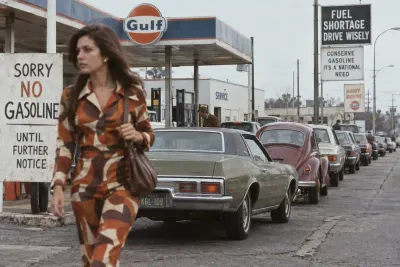
This is the entry I find myself explaining most, because it sounds like it shouldn't be a fashion story at all - it's an OPEC decision, not a runway decision. But polyester and nylon are literally made from petroleum feedstocks, and when the Arab oil-producing states embargoed exports to the US and other countries in October 1973 over the Yom Kippur War, the price of crude oil roughly quadrupled within a few months. That's not a marginal cost bump for an industry that had spent the previous several years building its whole value proposition - cheap, wash-and-wear, endlessly printable double-knit - around synthetic fiber being reliably cheap.
The practical effects showed up fast and in ways that read as almost comic in hindsight: fabric mills and garment manufacturers facing real synthetic-fiber shortages and cost spikes, trade press through 1974 full of anxious coverage about polyester supply, and a broader stagflation economy - rising prices paired with stagnant wages, the defining economic mood of the mid-70s - that made shoppers genuinely more price-conscious across the board, not just about fabric content specifically. You can see the ripple in how ready-to-wear was built through the back half of the decade: easy-care construction leaning harder into cotton-poly blends rather than pure synthetic, and a real design push toward garments that minimized fabric waste and labor cost, which is part of why unstructured, minimally-tailored pieces - the kind covered in elastic waistbands and easy-care construction - kept gaining ground over fitted, dart-heavy garments that ate more fabric and sewing time per piece.
I think the honest way to frame this is that the energy crisis didn't invent any of the decade's big design ideas - separates, easy-care knits, and minimal construction were already trending before 1973 - but it gave all of them a genuine economic tailwind that outlasted the embargo itself. Polyester and double-knit gets remembered today mostly as a punchline, all those loud prints and static-cling jokes, but it's worth remembering it was also, quite literally, a fabric whose entire cost structure was reshaped by a geopolitical event most people wouldn't think to connect to their closet at all.