The 1950s 1950s
Nylon
The decade's defining synthetic - cheap, durable, and easy-care, and the fiber that made affordable stockings and easy-wash blouses possible.
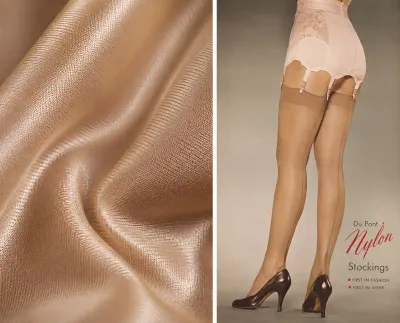
Nylon itself isn't a 1950s invention - DuPont introduced it in 1939 and nylon stockings were already a sensation by the early '40s, famous enough that wartime shortages actually caused "nylon riots" in 1945–46. What the 1950s really represents is nylon finally becoming a reliable, widely available everyday fabric once wartime material restrictions lifted for good - and a fabric that didn't need ironing the way cotton or linen did was still a genuinely big deal for anyone doing their own laundry.
DuPont's marketing through the decade leaned hard into the "miracle fiber" framing that had already worked so well in the run-up to the nylon riots - advertising copy consistently emphasized durability, quick drying, and resistance to wrinkling as genuinely liberating qualities for a woman managing her own household laundry, at a moment when domestic labor-saving was itself a major cultural theme running through appliance and homemaking marketing generally. That framing mattered enormously for hosiery specifically: nylon stockings could be washed in a sink and dry overnight, unlike silk stockings, which required much more careful handling and were prone to laddering and general fragility. The seamed nylon stocking became close to a daily-wear default for a huge portion of American and European women through the decade, with seamless versions arriving later in the '50s as knitting technology improved - itself a small but real shift in how a stocking was actually constructed, moving from a flat knit piece sewn up the back to a fully circular knit with no seam at all.
Beyond hosiery, nylon worked its way into blouses, lingerie, and a growing range of easy-care daywear, and DuPont's broader "better living through chemistry" messaging (the company's actual advertising slogan through much of the mid-century) positioned synthetic fibers generally as a modern, forward-looking alternative to natural materials that demanded more careful, old-fashioned upkeep. I think that's worth sitting with as a genuine mid-century value shift, not just a fabric story: convenience and easy maintenance were being actively marketed as virtues in their own right for the first time at real scale, and nylon was the fiber leading that argument before Orlon acrylic and other DuPont synthetics extended the same pitch to sweaters and knitwear later in the decade.