The 1950s 1950s
Novelty Atomic Prints
Playful screen-printed cotton featuring boomerangs, starbursts, and atomic motifs - the fabric expression of the decade's fascination with the Space Age and nuclear science.
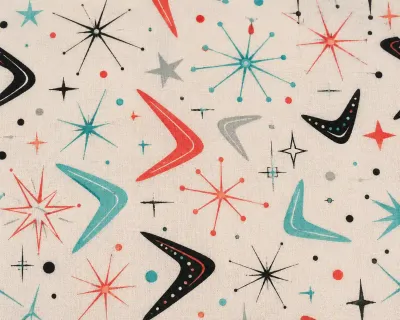
Novelty prints are where 1950s optimism (and, honestly, its slightly unnerving relationship with atomic power) shows up most directly on fabric - boomerangs, atoms, constellations, all screen-printed onto cheerful cotton.
A few distinct motif families run through this style, and they're worth separating out because each is drawing on a slightly different strand of the decade's imagination. Atomic and molecular motifs - orbiting dots around a central starburst, echoing textbook diagrams of an atom - draw most directly on nuclear science's sudden cultural prominence, equal parts genuine scientific optimism and a lingering, half-acknowledged unease about the same technology's more frightening implications. Boomerang and kidney shapes, appearing on everything from dress fabric to kitchen countertops, are pure mid-century design abstraction - asymmetrical, dynamic curved forms meant to suggest movement and modernity without depicting anything literal at all. Constellation and starburst prints lean into the era's parallel fascination with space and the coming Space Age, scattering stylized stars and comet trails across a print in a way that reads as forward-looking and optimistic rather than anxious.
All three families are really the same design impulse showing up across completely different product categories at once, which is why the "see also" comparisons to googie architecture and atomic-age furniture aren't incidental - a googie coffee shop's swooping, star-topped roofline, a boomerang-shaped kidney coffee table, and a novelty-print circus skirt are all drawing on an identical visual vocabulary: dynamic, asymmetrical, science-and-space-inspired abstraction, applied at every possible scale from a building down to a swatch of cotton. I think that's the real reason these prints still read as instantly, specifically "1950s" today in a way plenty of the decade's other fabrics don't - they're not just decorating a garment, they're a direct fabric-scale expression of an entire design movement that was reshaping architecture, furniture, and product design simultaneously, all working from the same optimistic, atomic-and-space-age visual language at once.