The 1960s mid-to-late 1960s
The Space Race and Fashion
A real, closely-followed national competition to reach the moon gave couture a genuinely new visual vocabulary to borrow from - astronaut white, helmet shapes, and synthetic materials standing in for imagined future hardware.
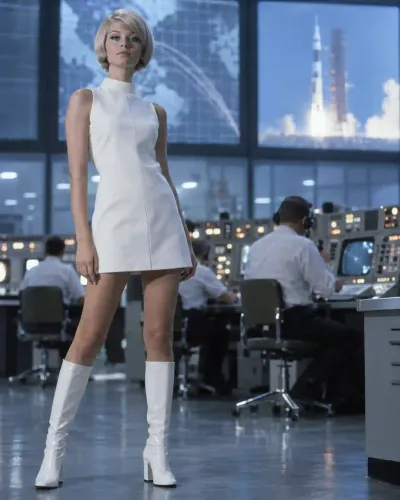
The American and Soviet space programs weren't background noise for this decade - they were front-page, closely followed news for most of it, from Yuri Gagarin's 1961 orbital flight through John Glenn's 1962 American answer to it, all the way to the 1969 moon landing that effectively closes out the whole race as a live competition. That sustained, high-stakes visibility is the real engine behind the Space Age silhouette and everything built around it - fashion wasn't reaching for a vague, generically futuristic mood, it was responding to an actual, specific, ongoing news story with real astronauts, real hardware, and real photographs circulating constantly.
André Courrèges and Pierre Cardin both built entire mid-decade identities translating that imagery fairly directly into wearable clothing - stark white and silver standing in for a spacesuit's palette, helmet-like hats and goggle-style sunglasses, geometric cutouts and stiff synthetic fabrics reading as engineered rather than sewn. None of this required much interpretive distance from the source material; a lot of it reads, quite literally, as fashion's own guess at what an ordinary woman might wear if she needed to look ready for a future that suddenly felt close and technologically plausible rather than a distant science-fiction fantasy.
I think what makes this entry genuinely distinct from ordinary "futuristic fashion" trends in other decades is how tightly the timeline actually tracks real events rather than a general cultural mood. The Space Age silhouette's rise and its eventual fade by the late 1960s line up closely with the space race's own most intense, most publicly visible years, giving way to the entirely different visual language of the counterculture and hippie movement right around the same moment the moon landing itself, in July 1969, effectively answers the question the whole race had been asking. Once the goal is actually achieved, the imagined-future aesthetic built around chasing it loses a real part of its charge.