The 1930s mid-to-late 1930s (1935-1939)
The Invention of Nylon
DuPont's fully synthetic fibre, first made in 1935 and announced in 1938 - unveiled to the public as stockings at the 1939 World's Fair, just in time to vanish into wartime parachutes.
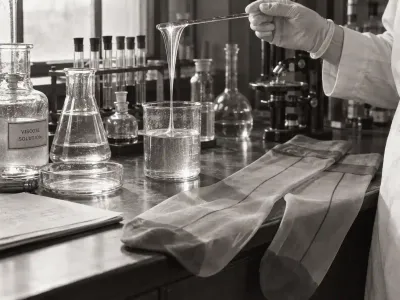
Nylon's big story happens in the 1940s, when it became a sensation, disappeared into the war effort, and caused riots when it came back. But it was invented in the 1930s, and the invention story is worth telling in its own right, because it marks the start of the synthetic fibres that would transform fashion for the rest of the century.
The work was done at the American chemical company DuPont, where a research team led by the chemist Wallace Carothers was investigating long-chain molecules called polymers. In 1935, the team produced a polymer that could be drawn out into strong, fine, elastic fibres - the first nylon. Unlike rayon, which is made from natural cellulose, nylon was built entirely from chemicals, which made it the first truly synthetic fibre. Sadly, Carothers didn't live to see its success; he died in 1937. DuPont announced nylon to the public in 1938, promoting it with the memorable claim that it was as strong as steel and as fine as a spider's web.
DuPont chose women's stockings as nylon's first big consumer product, because silk stockings were expensive, fragile, and dependent on imports from Japan, and nylon could be sheer and far more durable. Nylon stockings were shown at the 1939 New York World's Fair and first went on sale in Wilmington, Delaware, in October 1939. I think it's a fascinating moment in fashion history: the fibre that would define the 1950s was ready just as the decade - and peace - ran out. Within a couple of years it had been claimed for parachutes, and women wouldn't get to enjoy it properly until after the war.