The 1990s mid-to-late 1990s
Seamless Knitting
Garments knitted whole on the machine instead of cut from knitted cloth and sewn - Santoni's circular 'seamlesswear' machines, Shima Seiki's WholeGarment of 1995 and Issey Miyake's A-POC took hosiery's oldest trick and applied it to bodywear and fashion.
Most knitwear isn't knitted to shape. It's cut and sewn. A circular machine knits a continuous tube of fabric, and, as the Knitting Together heritage project explains for the East Midlands trade, wide tubes were cut into garment pieces while narrow ones became stockings and socks. Cut a T-shirt from jersey and you see the cost: curved offcuts for the bin, and seams that must be overlocked so they stretch with the cloth. A Shima Seiki executive puts the waste of cut-and-sew knitwear at around 25 per cent. Fully fashioned knitting, the older prestige method, shaped each piece on the machine, but the pieces still had to be joined. The 1990s made it practical to knit a whole garment in one go.
Hosiery got there first. Seamless stockings were knitted as a tube and shaped afterwards, and once heat-set nylon let them hold that shape they could rival fully fashioned ones. Italian four-feed Zodiac machines, introduced in 1961, helped cut the time to knit a stocking from about fifteen minutes in 1950 to around thirty seconds by 1980. Pantyhose came out of the same machines, and as far back as the 1930s roll-on girdle makers were knitting tubular, seamless foundations in different densities for different parts of the body.
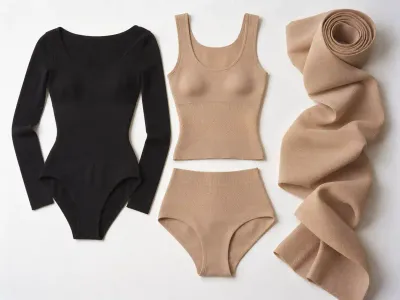
Then hosiery slumped. Textile World's account of the Italian firm Santoni says the 1980s crisis in stockings pushed its parent, the Lonati group, to build a prototype, the LM1, on hosiery technology. Santoni, founded in 1919 as Italy's first maker of sock machines and bought by Lonati in 1988, developed two families from it: single-jersey SM8 and double-jersey SM9 machines, whose garments went almost straight to the shops, with most of the cutting and sewing steps gone. In 1997 Santoni's core business became electronic circular machines for what the trade then called "seamlesswear". Electronic needle selection lets the stitch change as the tube grows, so one garment can have a firm band, a smooth body and an open panel with no seam between them. Underwear and bodywear suited it best, and the attraction is easy to see: a vest or brief with no side seams has nothing to show through a slip dress.
The V&A has a playful version from 1997. Wolford, the Austrian hosiery firm founded in 1949, commissioned Philippe Starck to design "StarckNaked": opaque tights joined by a thick band at the waist to a long tube of stretch fabric, worn as a skirt, a tube dress or, with two detachable straps, a strappy dress, and made longer or shorter by gathering or stretching. It's hosiery scaled up into a dress.
Japan came at the problem on flat-bed machines. Masahiro Shima, from Wakayama, founded Shima Seiki in 1962, and the company grew on an automatic glove-knitting machine - a glove being a small whole garment, fingers and all. Its WholeGarment machine made its international debut at the 1995 ITMA textile-machinery fair in Milan, knitting complete garments without any cutting, so they have no seams. Today, Nippon.com reports, a pullover takes about thirty minutes once the data is loaded.
The most radical version came last. In 1998 Issey Miyake began A-POC, "A Piece of Cloth", with the textile engineer Dai Fujiwara; Miyake's studio describes it as a single thread fed into an industrial knitting or weaving machine programmed by computer. The Met catalogues two A-POC pieces from spring/summer 1999, in cotton, nylon and polyurethane, not as dresses but as "kits", and the Praemium Imperiale's biography of Miyake calls A-POC "an interactive method that permits wearers to determine the final shape of the product." The wearer finished the garment.
For a dressmaker it's humbling: seams, darts, hems and neckbands all move into a programme written before the yarn goes in. The logic is familiar, though, from Hervé Léger's bandage dress: the shape comes from where the knit grips, not from where the cloth is cut.
Sources
- "Seamless succeeds" - Knitting Together: The Heritage of the East Midlands Knitting Industry
- "The Rupp Report: Santoni - A Seamless Success" - Textile World, December 2014
- Nakamura Masanori, "Shima Seiki Sets Sights on Sustainable Fashion" - Nippon.com, 3 August 2023
- 'StarckNaked' dress with built-in tights, Philippe Starck for Wolford, 1997 (T.131:1 to 3-2009) - V&A Collections
- "The Concepts and Work of Issey Miyake" - Miyake Design Studio
- Kit, Miyake Design Studio, spring/summer 1999 (2015.417) - The Metropolitan Museum of Art
- "Issey Miyake" - Praemium Imperiale laureate biography