The 1920s throughout the 1920s
Beading and Embroidery
How a beaded dress was made: glass bugles and sequins chained on with a tambour hook, panels worked flat before cutting, and the Paris houses, Kitmir and Lesage, behind the couture versions.
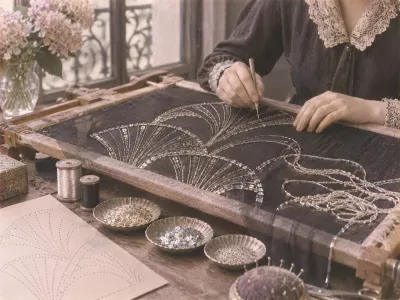
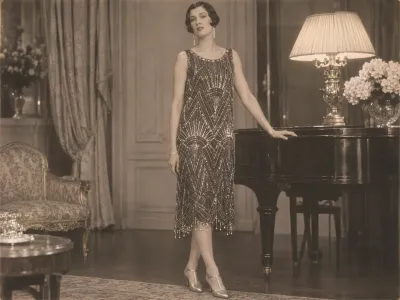
The Royal School of Needlework has a 1920s dance dress covered in spider webs. Each web is a circle of glass beads and pearls tambour-worked onto a layer of cream net, then couched onto a second layer of net, with the silver threads added separately. A thick line of beads bordered with pearls marks the dropped waist, and the net at the hem is simply left raw, with about five centimetres unbeaded. The school's record ties the decade's taste for beads and sequins to something practical: electric lighting was getting brighter and stronger, and glass on a dance floor finally had something to catch.
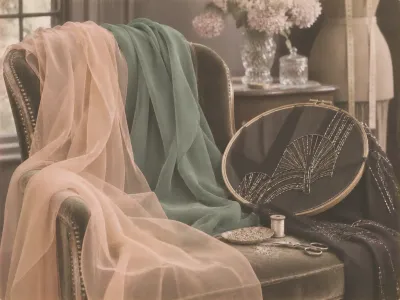
Almost all of that glass went on with a hook rather than a needle. Tambour work takes its name from the drum-like frame that holds the fabric taut. The Dundas Museum in Ontario, describing a 1920s dress given by Gladys McPherson, explains the method simply: the beads are strung in advance, and a fine hook poked through the fabric attaches them, working from the back, where the design is drawn and easiest to follow. Each pass of the hook pulls up a loop of thread and makes a chain stitch on the reverse, and a bead pushed along the thread is trapped on the right side by each stitch, so a skilled worker can lay a line of bugles almost as fast as she can draw. The catch is that she never sees the front until the frame is turned over. Once the beading was done, the Dundas account adds, the shapes were cut out of the beaded panels by hand, which is what "embroidered to shape" means in records of beaded evening dresses.
The materials were glass bugles (short tubes), round seed beads, pearls, paste, and sequins of metal or gelatine. The V&A's overdress of 1926, worn over satin by the violinist Daisy Kennedy so that it caught the light at recitals, shows how finely they could be combined: a songbird worked in minute blue and turquoise bugles, with gold beads for its beak and claws, iridescent gelatine sequins for its raised wing, tail and breast, and a single ruby-red bead for its eye.
Glass is heavy, and that is why the dresses underneath are so plain. The V&A's "Jour de Veine" by the Paris house of Jenny, from 1925-28, is embroidered silk satin backed with crêpe, its hem cut into six scallops "heavily decorated with heavy glass beads and bugle beads", and the whole dress is made of just two pieces, front and back, sewn together. Every dart or seam would interrupt the beading and add a stiff ridge; a straight chemise hanging from the shoulders lets the panels stay flat for the frame and lets the weight hang straight down. Owners were warned. The New Butterick Dressmaker of 1927 told readers never to put a beaded garment through a wringer, "for it would break the beads," to press it face down on a Turkish towel, and not to hang a dress in a bag if it was so "heavily weighted with trimming, such as beading" that it might stretch.
Couture beading came from specialist houses. Kitmir was founded in Paris in 1922 by Grand Duchess Maria Pavlovna, who had fled Russia after the revolution and employed fellow émigrés, drawing on the stitched decoration of Central and Eastern European dress. The V&A says Kitmir embroidered exclusively for Chanel in this period; its gold thread and bugle beads cover a black georgette dress designed in 1922 for spring/summer 1923. Lesage dates itself to 1924, when Albert Lesage joined the Paris workshop of the embroiderer Albert Michonet, and its clients came to include Vionnet and Schiaparelli. The Costume Society's review of the house's centenary exhibition calls the 1924 arrangement a partnership; it is often told as a straightforward purchase, so the details are worth treating with care. By 1940 Lesage was embroidering Schiaparelli's lilies in occupied Paris.
Sources
- Evening dress, 1920s, net with tambour-worked beads and pearls (RSN.1094) - Royal School of Needlework Collection
- "Fashion in the 1920s: Gladys McPherson" - Dundas Museum & Archives
- Overdress of tulle embroidered with bugle beads, gelatine sequins and seed pearls, worn by Daisy Kennedy, 1926 (T.239 to B-1982) - V&A Collections
- Evening dress 'Jour de Veine', embroidered silk satin with glass beads, Jenny, Paris, 1925-1928 (T.214-1953) - V&A Collections
- Evening dress, silk georgette embroidered by Kitmir, Chanel, spring/summer 1923 (T.86-1974) - V&A Collections
- Babette Radclyffe-Thomas, "Lesage: 100 years of fashion and decoration at La Galerie du 19M" (2025) - The Costume Society
- The New Butterick Dressmaker (Butterick Publishing Company, 1927) - Internet Archive