The 1970s late 1970s
The Punk Silhouette
Torn, safety-pinned, and deliberately deconstructed - bondage-influenced pieces out of London's mid-70s scene that turned falling apart into the whole point.
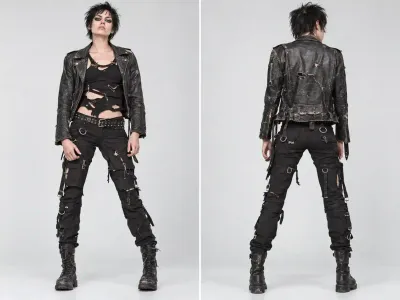
Every other silhouette in this section is, on some level, about a garment being well made for its purpose - draping correctly, closing cleanly, flattering the body in it. Punk inverts that premise, and it's the one 70s shape that still looks radical. But when you look closely at the surviving clothes, the damage turns out to be carefully built, and the shape underneath it is very specific: narrow, hobbled legs, and a top half that is loose, slashed, strapped or hairy.
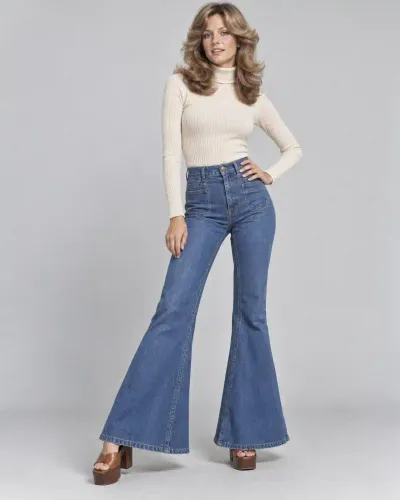
Start at the legs, because that's where punk broke hardest with the decade. After years of bell-bottoms and flowing maxis, the punk leg was straight, black and tied together. The V&A's bondage suit, designed by Westwood and McLaren for spring/summer 1976 and described by the museum as genderless, is a black cotton jacket and trousers. The trousers have a zipped seam running under the crotch, a detachable "bum flap" of black towelling, and straps between the legs meant to hobble the wearer's stride, all fastened with snaps, D-rings and spring links. The museum traces the parts to army combat gear, the motorcyclist's Belstaff jacket and fetish wear. As a pattern it's a pair of straight-leg trousers, but the crotch seam has become hardware and the strap limits the step, so the outline it makes is the opposite of the flared, swinging leg the rest of the decade wore.
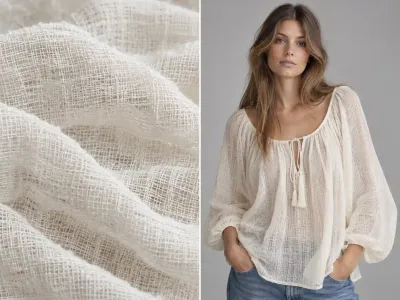
The top half came in cheap cotton muslin, the same loosely woven cheesecloth the hippies had used for peasant shirts. The "Destroy" shirt of 1977 is white cheesecloth with sleeves cut too long and finished with straitjacket clasps and D-rings, the shoulders left partly open and closed with Velcro tabs, screen-printed with a swastika, an inverted crucifixion and Sex Pistols lyrics. Women's versions were just as engineered. A black muslin top of 1977 is asymmetric, with slashed sleeves and shoulders, hardware attached, Velcro closures at the shoulders and the sides slit up to the bust - yet the inside of the neck is lined with silk. A white one, dated by the museum to 1976, is printed with the Pistols' "God Save the Queen" image, has lyrics safety-pinned to the front, and is ripped at the shoulders. To my eye the damage sits exactly where a pattern-cutter would put a design line: shoulders, sleeves, side seams.
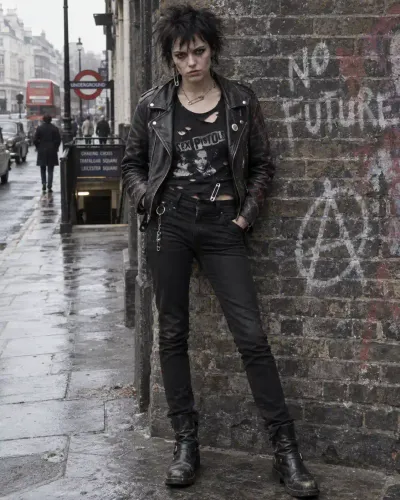
Then the knitwear, which gave punk its proportions. The V&A says the loose-knit mohair sweater "set the punk fashion for torn and unravelling sweaters"; its women's example is cropped and long-sleeved, in red, orange and yellow. Hand-knitted copies followed: the one Min McIlwain wore in 1979 had its arms set in just above the waist, like the ones sold at Seditionaries - which makes it, in effect, a dolman, the same deep sleeve that would become the 1980s batwing. Big, hairy and loose on top over narrow black legs: that's the punk outline in one line. The Encyclopedia of Clothing and Fashion lists mohair sweaters and tight jeans among the cheap staples punks across Britain built their look from.
What held it together, literally, was the safety pin. Dick Hebdige's account of punk, summarised in the same encyclopedia entry, treats it as bricolage: an object meant to fasten a baby's nappy, pushed through a nose or into a ripped jacket, and given a new meaning by where it was worn. At home that was the whole method - rip, pin, write on it. Zandra Rhodes zigzag-stitched the edges of her rips in 1977, and by the 1990s factories were sandblasting the damage in, but the street version in the 70s was made by the wearer. The punk and anti-fashion entry follows the women who wore it.
Sources
- Bondage suit, black cotton, Vivienne Westwood and Malcolm McLaren, 1976 (T.252&A-1989) - V&A Collections
- Shirt, cheesecloth muslin with straitjacket sleeves, 'Destroy' design, Westwood and McLaren for Seditionaries, 1977 (T.773-1995) - V&A Collections
- Top, women's, black muslin, Westwood and McLaren, 'Seditionaries', 1977 (T.92-2002) - V&A Collections
- Top, women's, white muslin with 'God Save the Queen' print, Westwood and McLaren, 'Seditionaries', 1976 (T.93-2002) - V&A Collections
- Jumper, women's, cropped loose-knit mohair, McLaren and Westwood for Seditionaries (T.94-2002) - V&A Collections
- Coat (lifeguard's tunic), with notes on the hand-knitted mohair sweater worn with it by Min McIlwain, 1979 (80.531/1) - London Museum
- Frank Cartledge, "Punk", Encyclopedia of Clothing and Fashion - Encyclopedia.com