The 1980s throughout the 1980s, peaking late in the decade
Sequins and Lame
Metallic thread and reflective plastic discs, applied densely enough to turn a whole garment into a light source - the finishing touch the decade's maximalist eveningwear kept reaching for.
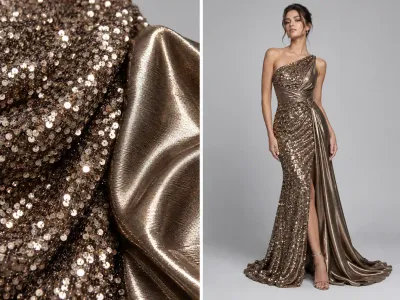
Lamé is a fabric woven with actual metallic thread running through it, catching and reflecting light across its whole surface rather than at isolated points; sequins do something related but more concentrated, small reflective discs stitched or glued on individually or in strips, densely enough in this decade's eveningwear that they could cover a garment's entire visible surface rather than accenting just a neckline or hem. Both were established techniques well before the 1980s, but this decade pushed the density and scale of their application further than most that came before it.
That escalation lines up directly with the prom silhouette's broader appetite for visual maximalism - a fully sequined bodice paired with a full taffeta and tulle skirt reads as considerably more eventful under gymnasium or ballroom lighting than a single metallic accent would, and "more eventful" is genuinely the design brief this decade's eveningwear kept reaching for as it went on. Christian Lacroix's late-decade couture leaned into exactly this kind of dense, light-catching embellishment as a core part of his maximalist signature, and that appetite trickled down fast into mall prom-dress racks.
I think sequins and lamé earn their place as a distinct fabric entry, rather than a footnote to whatever silhouette they're dressing, because the sheer density of application is itself the story - this isn't decoration added sparingly to an otherwise plain garment, it's embellishment treated as the garment's whole visual identity. Few decades on this site push a single finishing technique this far past subtle accent and into total coverage.