The 1950s 1950s
Hollywood's Costuming Influence
Studio costume designers dressed the era's biggest stars, and what appeared on screen filtered straight down into what ordinary women wanted to wear.
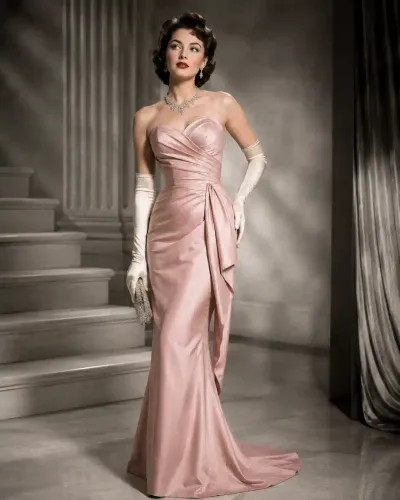
This is one of the clearest style pipelines of the whole decade - a costume designer dresses a star for a single film, and within a season department stores are selling copies of the look. Fashion press and film press were basically talking to each other constantly.
Edith Head is the towering figure of this whole pipeline - head costume designer at Paramount for decades and, by sheer volume and visibility of her work through this decade, probably the single individual most responsible for what "movie star glamour" actually looked like to an ordinary 1950s moviegoer. Her work on films like Roman Holiday (1953) and Sabrina (1954) - the latter notably also drawing on early Givenchy pieces for Audrey Hepburn's Paris-set wardrobe, a nice direct overlap between studio costuming and actual Paris couture - shows exactly how directly a costume choice for one specific scene could ripple outward into broader fashion conversation almost immediately after a film's release. Head's Oscar-winning run across the decade gave her a level of public visibility unusual for a costume designer at the time, closer to how a star director might be discussed than the more anonymous, purely functional role costuming had often occupied earlier in Hollywood's history.
The pipeline from screen to store was also remarkably fast and structurally deliberate, not just an informal cultural ripple - manufacturers and department stores actively licensed and produced affordable copies of notable film costumes within a season of a movie's release, explicitly marketed with the film or star's name attached to trade on the association directly. Marilyn Monroe's costumes (Travilla was her most closely associated designer through several major films this decade), Grace Kelly's more restrained, tailored elegance both on-screen and in her actual public life, and countless other star-and-designer pairings all fed the same fast cycle: a costume decision made for a specific scene's dramatic or narrative purpose could, within months, be sitting on a department-store rack as a mass-market interpretation any ordinary woman could buy. I think that speed is really the headline story here - Hollywood wasn't simply reflecting existing fashion trends back at audiences, it was often generating them first, at a pace that gave the era's magazine and department-store fashion machinery a genuinely reliable, recurring source of new material to chase every single season.