The 1950s 1950s
The Growth of Ready-to-Wear
Department stores and mass manufacturers scaled up standardized sizing and factory production, making fashionable clothing dramatically more accessible than the couture and dressmaker model that came before.
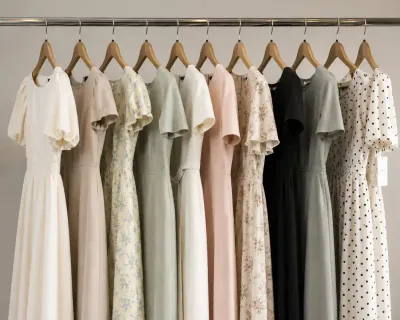
This is a real structural shift, not just a style one - standardized sizing meant a woman could buy a dress off a rack instead of having one made to her own measurements, which changes the whole economics of getting dressed.
The gap closed faster than most casual accounts of this decade give it credit for, and the mechanism is worth spelling out. Seventh Avenue manufacturers in New York, along with their counterparts in other cities, had gotten genuinely skilled by this decade at watching Paris couture collections closely - sometimes through licensed pattern adaptations, sometimes through more informal, faster copying - and translating a season's silhouette into mass-producible garments within months rather than the year or more such adaptation might have taken a generation earlier. Designers like Norman Norell, covered elsewhere in this section, are the clearest individual proof that "ready-to-wear" and "couture-quality construction" weren't actually incompatible categories by this point, even if plenty of cheaper mass-market goods still cut real corners to hit a lower price point.
Standardized sizing is really the unglamorous engine underneath all of this, and it owes a surprising amount to a 1939–41 USDA-sponsored study that measured close to fifteen thousand American women's bodies for garment-fitting purposes, later adapted into the first broadly used commercial sizing charts for women's ready-to-wear. That standardization meant a manufacturer could produce a single well-fitting pattern across a real range of sizes with reasonable confidence, rather than treating every garment as an individual fitting problem the way made-to-measure dressmaking always had - and it's the same basic sizing challenge the Victorian era's earliest department-store ready-mades were still working out imperfectly, discussed in that section, finally arriving at something closer to a genuine, dependable solution seventy-odd years later. Between faster Paris-to-Seventh-Avenue translation and dependable sizing, an ordinary department-store shopper in 1955 had access to fashionable, reasonably well-fitting clothing at a speed and price point that would have been simply unimaginable to her Victorian-era counterpart, and that access is arguably as significant a story about this decade's fashion as any individual silhouette covered elsewhere in this section.