The 1950s early-to-mid 1950s
The Shirtwaist Dress
A button-front bodice borrowed from menswear shirting, paired with a full or slim skirt - the era's most versatile daywear shape.
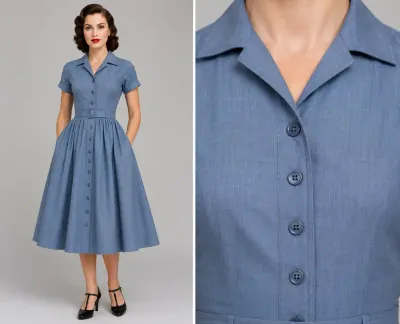
The shirtwaist is the workhorse silhouette of the decade - practical enough for daytime, but still cinched at the waist in a very 1950s way. It's the shape I'd point to first if someone asked what "ordinary" 1950s fashion actually looked like, as opposed to the runway extremes.
Early in the decade, a shirtwaist typically pairs its button-front, collared bodice with a genuinely full skirt - not quite the New Look's full twenty yards, but clearly drawing on the same silhouette logic, gathered or pleated to a real fullness that a stiffened petticoat underneath would hold out. That pairing is part of what made the shirtwaist such an effective everyday garment: it borrowed the era's fashionable fullness without the New Look's formality or fabric extravagance, translating a couture idea into something a woman could actually do housework, errands, or an office day in.
As the decade moves toward its midpoint and the wiggle dress starts pulling the fashionable silhouette narrower, the shirtwaist follows the same general drift - skirts trimming down from full circle shapes toward slimmer, less voluminous cuts, though rarely going as extreme as the wiggle's true narrow sheath, since a shirtwaist's whole identity is built around practicality and ease of movement rather than the wiggle's deliberately restrictive line. That flexibility is really the point of this entry: the shirtwaist isn't defined by one fixed skirt shape the way the New Look or the wiggle dress are - it's defined by the button-front bodice construction, and it happily rides along with whatever skirt silhouette happens to be fashionable underneath it at a given moment. That adaptability is exactly why I keep calling it the decade's workhorse - it's less a single dramatic look and more a reliable formula that absorbed the era's changing tastes without ever really going out of style itself.