The 1950s 1950s
Conformity Culture and Dress
The decade's anxious political climate fed a broader cultural pressure toward conformity, visible in how codified 'appropriate' dress became for both men and women.
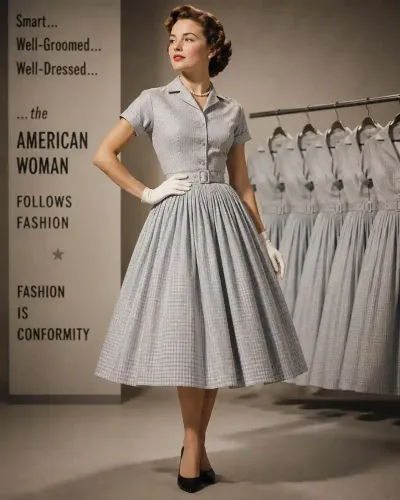
There's a real throughline between the era's political anxieties and its dress codes - a fairly narrow, agreed-upon idea of what "appropriate" looked like, for men in gray flannel suits as much as for women in structured daywear.
The pressure itself is well documented outside fashion specifically - sociologist David Riesman's The Lonely Crowd (1950) and journalist William H. Whyte's The Organization Man (1956) both diagnosed, from different angles, a culture increasingly oriented around fitting smoothly into institutions and peer expectation rather than standing apart from them, and dress was one of the most immediately visible ways that pressure played out day to day. A man's gray flannel suit and a woman's neatly structured shirtwaist or day dress functioned as a kind of visible membership card - proof, at a glance, that the wearer understood and accepted the prevailing social contract, in a decade genuinely anxious about anything that read as deviant or suspicious, Cold War politics included.
That pressure started visibly cracking well before the decade actually ended, and youth culture is really where the cracks show up first and most clearly. The rise of teen fashion gave teenagers a style vocabulary genuinely separate from their parents' conformist daywear, and rock and roll's rapid rise through the mid-to-late '50s brought a visibly rebellious style sensibility - leather jackets, jeans, a rougher, more overtly sexual presentation - into mainstream youth culture for the first time at real scale. By the very end of the decade, the sack dress controversy and the increasingly unfitted, waist-skipping silhouettes that followed it were, in their own quiet sartorial way, doing something similar to what youth and rock culture were doing more loudly: breaking with an established, rigidly agreed-upon idea of what "appropriate" dress looked like. I think it's genuinely useful to read those seemingly unrelated threads - silhouette experimentation in Paris couture, teenagers embracing rock and roll style at home - as two expressions of the exact same underlying pressure finally starting to give, right at the seam between this decade and the more openly rebellious one that follows it.