The 1980s late 1980s
The Asymmetric Hemline and Mullet Hem
A skirt or dress cut deliberately shorter in front and longer in back - a single unbalanced hemline doing the work of two different lengths at once, and refusing to settle on either.
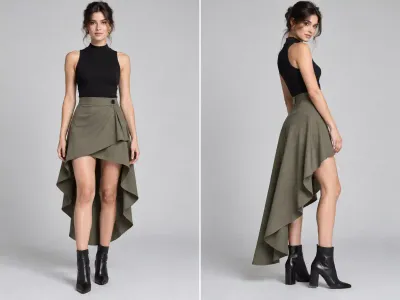
An asymmetric or "mullet hem" skirt is cut with a hemline that isn't level around the body at all - shorter at the front, sometimes dramatically so, and trailing longer at the back, occasionally down to the calf or floor. Achieving this cleanly is a genuinely different pattern-cutting problem than a standard, evenly hemmed skirt: the hem curve has to be calculated and graded carefully around the whole garment so the transition between short front and long back reads as an intentional design line rather than a mistake, usually by manipulating the hem's curve independently of the skirt's actual waist and side seams.
The appeal was in exactly that unresolved quality - a wearer got the visible leg and movement of a short skirt at the front while still carrying the length and drama of an evening-appropriate hemline behind her, refusing to fully commit to either a daytime-practical or evening-dramatic length. That's consistent with a lot of this decade's late-period instinct toward combining silhouettes and eras that earlier fashion logic would have kept separate - the prom silhouette's maximalist volume and a much shorter, more casual hemline showing up in the very same garment rather than in two distinct outfits.
I think this hemline construction is worth its own entry because it's a genuinely clever solution to a design tension - short versus long, casual versus dramatic - rather than a compromise between the two. Instead of picking a single length and committing to what it communicates, the asymmetric hem lets a single garment communicate two different things simultaneously, which is a distinctly late-1980s way of refusing to choose.