The 1950s mid-1950s
Capri Pants
Cropped, fitted trousers that hit mid-calf - a casual, faintly rebellious counterpoint to the decade's full skirts.
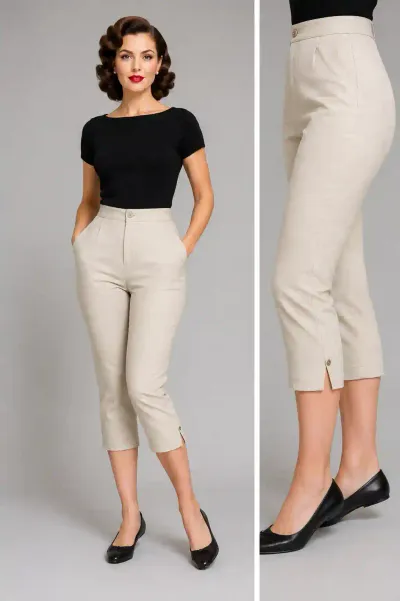
Capris are where the decade's sportswear instincts show up most clearly - a garment built for actually moving in, at a time when so much womenswear still assumed you'd be standing still and looking composed. Worth being precise about the name here: "Capri pants" specifically trace to German designer Sonja de Lennart's Capri Collection, hitting the market around 1948 - Claire McCardell's earlier American cropped "clam digger" trousers are a related but distinct thread in the same general direction, not the same garment.
Reception was mixed in ways that tell you a lot about the decade's anxieties around women wearing trousers at all. Capris were embraced quickly as vacation and leisure wear - practical for the era's growing car culture, for gardening, for lounging at home - but plenty of contemporary etiquette commentary treated them as borderline inappropriate for anything more formal than the most casual daytime settings, and some restaurants and workplaces in this decade explicitly barred women in trousers, capris included, well into the following years. That's the same broad discomfort with women's trousers that runs through a good deal of mid-century dress commentary generally, just applied to a specific cropped silhouette rather than to full-length pants.
The two lineages - de Lennart's Capri Collection and McCardell's earlier clam diggers - really represent two different starting problems arriving at a similar answer. McCardell's version grew directly out of her broader "American Look" philosophy of functional, mobile sportswear, cropped simply because a shorter leg made sense for the casual, active life she was designing for. De Lennart's, developed on the Italian island of Capri and named for it, was more explicitly a resort-wear invention - cut close to the leg and cropped specifically to suit the Mediterranean climate and the glamorous, jet-set leisure culture the island itself had come to represent by the late 1940s. Both landed on roughly the same silhouette from different directions, which I think says something real about cropped, fitted trousers being a genuinely obvious solution once women's sportswear design in general started taking practicality seriously - it's less that one designer copied the other, and more that two people solving a similar problem, on two different continents, converged on the same answer.