The 1950s mid-to-late 1950s
Car and Drive-In Culture
The rise of car ownership and drive-in culture - movies, diners - helped push casualwear like capri pants, sweater sets, and saddle shoes into genuinely mainstream daily use.
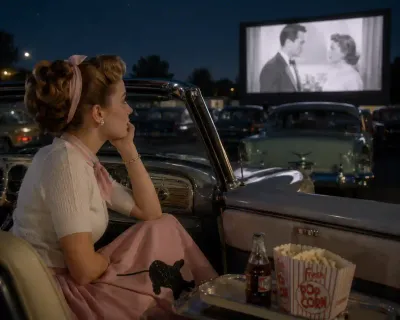
Cars change what clothes need to do, practically speaking - sitting, getting in and out, running into a drive-in for a burger - and a lot of the decade's casualwear boom tracks pretty closely with how much more mobile everyday life became.
Drive-in theaters are maybe the clearest single example of a venue actively reshaping what people wore to it. Attending a drive-in meant sitting in a car for a couple of hours, often getting in and out to visit a snack stand, in a setting far more casual and physically relaxed than an indoor cinema's fixed rows of seats - which meant it rewarded exactly the kind of comfortable, easy-movement casualwear that capri pants and sweater sets were built around, rather than the more structured daywear that going into a downtown theater might still have called for. Drive-in numbers exploded through the decade, from only around a hundred US locations right after the war to roughly a thousand by the late 1940s and nearly four thousand by the late 1950s, and each one was effectively training an entire generation to treat casual, car-friendly dress as appropriate for a genuine social outing, not just for lounging at home.
Diners and drive-in restaurants did similar cultural work from a slightly different angle - informal, quick, and typically involving getting in and out of a car multiple times over the course of an evening (parking, walking to a counter or car-hop service, sliding back into a booth or the car seat itself), all of which favored practical, easy-fitting clothes over anything requiring careful arrangement or a rigid understructure. Saddle shoes, already a comfortable, sturdy campus staple, translated perfectly into this setting; capri pants let a young woman get in and out of a car repeatedly through an evening without fighting a full skirt each time. I think the throughline across both venues is the same: mobility itself became a genuine style requirement for the first time at real cultural scale, not just a practical afterthought, and the casualwear boom this section covers elsewhere is largely the wardrobe's answer to that new requirement.