The 1950s 1950s
Pedal Pushers
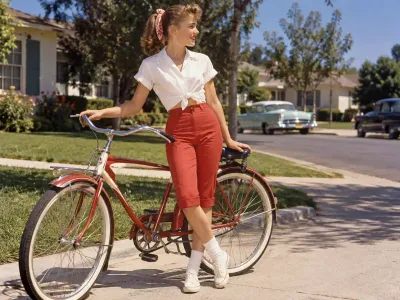
Straight, just-below-the-knee trousers, often cuffed or rolled, named for keeping clear of a bicycle chain - looser and more casual than capris, and the everyday play-trouser of teenagers and housewives alike.
Pedal pushers and capri pants get mixed up all the time, and I understand why - they're both cropped trousers worn by women in the 1950s. But they're different garments, with different shapes and slightly different personalities, and it's worth separating them.
Pedal pushers were the more casual and sporty of the two. They were cut fairly straight, not tight, and ended just below the knee or at the upper calf - shorter than most capris - and they were very often finished with a turned-up cuff or simply rolled. The name explains the purpose: they were practical trousers for cycling, short enough that the hem stayed clear of the bicycle chain and pedals, and loose enough to move freely. Capris, by contrast, were slimmer and closer-fitting, usually cropped lower on the calf or near the ankle, often with small side slits, and they had a more glamorous, resort-wear image.
Cropped cycling trousers were around in the 1940s, but pedal pushers became a real fashion in the 1950s, especially in the United States. They were made in cotton twill, denim, gingham, and bright solid colours, and worn with a tucked-in blouse, a sweater set or a knotted shirt, and flat shoes - saddle shoes, sneakers, or ballet flats. They were particularly popular with teenage girls, for whom they became part of a casual, youthful uniform, and with women at home for gardening, housework, and weekend leisure.
What I find interesting about pedal pushers is where they sit in the decade's arguments about women and trousers. Like capris, they were strictly leisure clothes, and many schools, offices, and restaurants didn't allow women to wear trousers at all. But pedal pushers were so clearly practical and casual, and so closely linked to wholesome activities like cycling, that they seemed less of a statement than slim, sexy capris. That made them a comfortable, accepted way to wear trousers for a huge number of ordinary women and girls. They're a good reminder that the 1950s weren't only about petticoats and full skirts; there was a very active, sporty wardrobe running alongside it all.