The 1950s throughout the 1950s
The Bikini
Introduced in 1946 and still controversial a decade later - a two-piece swimsuit that took years of slow, resistant mainstreaming before it stopped being a scandal and started being ordinary beachwear.

The French engineer Louis Réard showed the bikini at the Piscine Molitor, a public pool in Paris, on 5 July 1946. He named it after Bikini Atoll, the site of recent American atomic tests, betting that a swimsuit could make the same kind of explosion. No professional model would wear it, so he hired Micheline Bernardini, a dancer at the Casino de Paris, and printed newspaper type across the fabric as a joke about the headlines he expected. Time and the Smithsonian both repeat the story that she received some 50,000 fan letters. What it showed was the navel. Two-piece suits weren't new - the 1930s maillot already had a two-piece rival by the end of that decade - but they came up to the waist.
Réard wasn't alone. The couturier Jacques Heim sold a small two-piece he called the Atome, and popular histories have the two men racing each other to market in the summer of 1946. Richard Martin's entry on Heim in Contemporary Fashion tells it differently, dating the Atome to 1950, "considerably after the bikini incident", and saying it reached a broader public. Either way, the name that stuck was Réard's, and it stuck to a lot of suits that were much more modest than his.
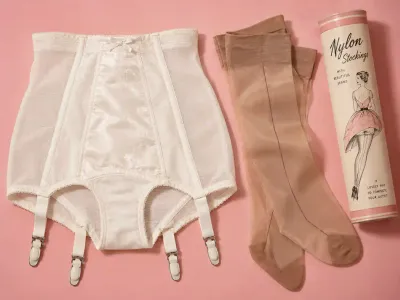
That's the part of the story that belongs to the 1950s: how slowly the real thing spread. The V&A has a British two-piece by Trulo from the mid-1950s, catalogued as a bikini, in raspberry pink polished cotton with a pale pink flower print. It has a bandeau bra with a removable halter strap and lined cups, and high-waisted pants with a wrap-over front, shirred sides and a metal zip at the back. Its label cites patents filed in 1936 for elastic shirring and ruching, which give stretch to fabric that has none. It's a well-made suit - and it covers the navel completely. That, much more than Réard's, was what most women bought. With its lined cups, shirring and zip, it's built more like the decade's foundation wear than like a scrap of fabric.
Official resistance was real. When Eric Morley organised a swimwear contest in London in 1951, the event that became Miss World, the Swedish winner Kiki Håkansson was crowned in a bikini on 29 July at the Lyceum Ballroom. Pope Pius XII condemned it, and afterwards bikinis were banned from the contest and replaced with more modest swimwear. American home sewing tells the same story at a slower pace. In the Commercial Pattern Archive, the earliest pattern indexed under "bikini" is Vogue 6447, a bikini and beach cover-up of 1965.
The real bikini stayed visible anyway, mostly through pictures. The V&A has late-1940s watercolours by the London commercial artist Wilfrid Addey of calendar pin-ups in bikinis, and pin-up photography kept it circulating through the decade - Bettie Page made her own, and in Miami the photographer Bunny Yeager sewed them for anyone who asked. Resort dressing helped too: the Pucci ensemble described under capri pants pairs slim trousers with a bikini top. What strikes me is the gap between a garment's invention and its adoption. Here it's nearly two decades, filled with modest copies, bans and home-made versions, before the bikini became ordinary beachwear - and by then Rudi Gernreich was already testing how much further a swimsuit could go.
Sources
- Emily Spivack, "Swimsuit Series, Part 3: Is Today Truly the 66th Anniversary of the First Bikini?" - Smithsonian Magazine, 5 July 2012
- Megan Gibson, "Micheline Bernardini Models the First-Ever Bikini", Top 10 Bikinis in Pop Culture - TIME, 5 July 2011
- Richard Martin, "Heim, Jacques", Contemporary Fashion (Gale) - Encyclopedia.com
- Bikini, Trulo, mid-1950s - V&A Collections
- Wilfrid R. Addey, 'Pin-up' wearing a purple bikini and smoking a cigarette, late 1940s - V&A Collections
- "Kiki Hakansson, the first Miss World, passes away at 95" - The Week, 6 November 2024
- Vogue 6447, Bikini and beach cover-up, 1965 - Commercial Pattern Archive, University of Rhode Island