The 1930s throughout the 1930s
The Fox Fur Stole
Silver fox thrown over a suit or gown - often a whole animal, head, paws and tail included - was the decade's ultimate status accessory, with dyed rabbit as the everyday stand-in.
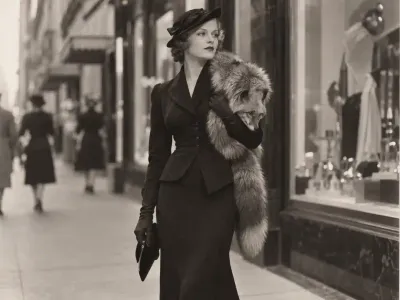
If there's one accessory that makes a photograph read as "1930s" immediately, it's a fox fur slung over one shoulder. Fur had been fashionable for centuries, of course, but this decade had a very particular way of wearing it: not as a coat, but as a stole or scarf draped across the shoulders of a slim suit or an evening gown, frequently with the animal still recognisably an animal.
The "animal scarf" is the version people find startling now. A whole fox pelt - sometimes two - was finished with the head, glass eyes, paws, and tail intact, and a spring clip hidden in the jaw let the fox "bite" its own tail or a paw to hold it in place. Worn over a tailored suit with a tilted hat and gloves, it was the height of smart daytime dress. For evening, a stole of silver fox thrown over bare shoulders was the look, and Hollywood loved it: long, pale, fluffy fur photographed beautifully on black-and-white film, and it framed a star's face and shoulders in exactly the right way.
Silver fox was the prestige fur. It came largely from fox farms, which had been breeding the silvery colour variety in Canada and the northern United States since around the turn of the century, and a good matched pair of pelts was expensive. The shape suited the moment too: a stole adds visual width and softness at the shoulder, balancing a narrow bias-cut skirt, which is the same trick padded shoulders were doing on day clothes. Below silver fox came red fox, dyed fox, and then an enormous trade in cheaper furs - rabbit, sold as "coney" and dyed or sheared to imitate something grander, was how a woman on a Depression budget got the look.
I'll be honest that this is one of the harder entries for me to write enthusiastically, because a clip-jawed fox is hard to see as anything but a dead animal today. But it's impossible to understand 1930s dress without it - fur was the single clearest signal of money and polish in a decade obsessed with both, and a surprising number of vintage animal scarves survive in family attics for exactly that reason: women kept them long after they stopped wearing them, because they had cost so much.