The 1930s throughout the 1930s (Eugénie craze 1931)
The Tilted Hat and the Eugénie Craze
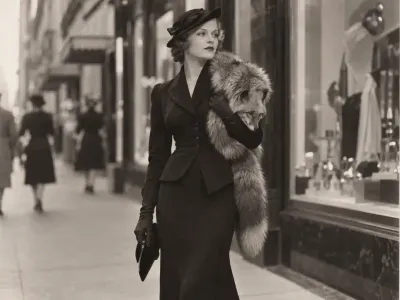
Small hats worn tipped over one eye - the defining millinery of the decade, sparked by a feathered 'Empress Eugénie' hat that Garbo wore on screen and everybody copied.
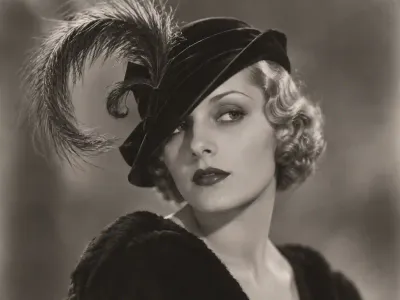
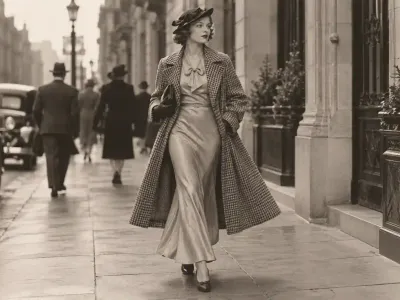
The 1920s were the decade of the cloche - a close-fitting, bell-shaped hat pulled right down over the head so you could barely see the wearer's eyes. The great Paris house of Reboux was famous for cloches cut and shaped on the client's own head. The 1930s swept that away almost at once. Hats shrank, perched and tilted, worn at a steep angle over one eye or one ear to show off the carefully waved hair underneath. It's one of the quickest ways to tell a 1930s photograph from a 1920s one.
The moment usually credited is the Eugénie hat. MGM's Romance, which opened in New York in August 1930 with gowns by Adrian, was a period picture, and in it Greta Garbo wore a small, tilted hat in the manner of the Empress Eugénie of France - Worth's great patron - in the 1860s, when Victorian bonnets were shrinking into small, perched shapes. By 1931 the "Eugénie hat", small and tipped sharply to one side, was everywhere. Photoplay claimed that year that the style had sold to over a million women in America, in the depths of the Depression, and gave Garbo all the credit. But the same article quoted the New York milliner Ferle Heller, who said she had seen Suzanne Talbot show the shape in Paris more than two years earlier, that "Empress Eugenie" was "a trick name thought up by some smart advertiser," and that her own wealthy customers wouldn't touch it until they had seen it on Garbo. Both things can be true: Paris had the idea, and Hollywood sold it. The craze burned out quickly, as crazes do, but the tilted angle stayed for the rest of the decade.
After that, 1930s millinery got more and more playful: berets, pillboxes, tiny toques, doll hats and sculptural shapes decorated with veils, bows, feathers and flowers. Reboux, which had once made hats for the Empress Eugénie herself, kept going under the milliner Lucienne Rabaté. The V&A has a Reboux "tip-tilted cap" of about 1934, covered entirely in blue feathers with a bluebird mounted on it, wings open, and a pointed Rabaté evening hat ringed with iridescent monal pheasant feathers, the sort of thing Vogue showed in a 1934 feature on "Dinner-Dancing Hats". In New York, the Metropolitan Museum has a small evening hat of wool and feather by Sally Milgrim from about 1932. And plenty of women made their own. Vogue pattern 5514 of 1931, in the Commercial Pattern Archive, is a beret-type hat "with tricorn effect" for 25 cents, cut from just a hat piece, a band and a lining - a quick job for anyone who could sew.
At the most extreme end, Elsa Schiaparelli worked with Salvador Dalí on the Shoe hat of 1937-38, one of the stars of the surrealism and fashion entry. The V&A's example is blue wool felt in the shape of a high-heeled shoe, with a fuchsia pink velvet heel. It grew, the museum explains, out of a 1933 photograph Gala Dalí took of her husband wearing a woman's shoe on his head, and this one belonged to Gala. It's a long way from Garbo's little hat, but it rests on the same idea: a hat as a small, tilted piece of theatre on top of the head rather than a covering for it. For me the Eugénie story is still the clearest example of how much Hollywood was shaping everyday dress by the 1930s. A single costume on a single star could change what women all over the world wore on their heads - even if, as Ferle Heller would have reminded you, Paris had thought of it first.
Sources
- Romance (1930) - AFI Catalog of Feature Films, American Film Institute
- Photoplay, July-December 1931, page on Garbo and the Empress Eugénie hat - Media History Digital Library (Lantern)
- Hat (tip-tilted cap with bluebird mount), House of Reboux, about 1934 - V&A Collections
- Hat, silk and monal pheasant feathers, Lucienne Rabaté for Reboux, mid-1930s - V&A Collections
- Evening hat, wool and feather, Sally Milgrim, about 1932 - The Metropolitan Museum of Art
- Vogue 5514, Misses' and women's hat of the beret type, tricorn effect, 1931 - Commercial Pattern Archive, University of Rhode Island
- Shoe hat, Elsa Schiaparelli with Salvador Dalí, 1937-38 - V&A Collections